 uogent
®
uogent
®
Analysis / Advanced Air Mobility
Cargo Before Commuters: India's Real AAM Launchpad
India's advanced air mobility story is more likely to begin with diagnostic samples, urgent cargo, and repeatable logistics corridors than with a passenger air taxi commute.

India's Advanced Air Mobility story will probably not begin with a CEO flying from Gurugram to Connaught Place. It will begin with a diagnostic sample, a unit of blood, a high-value machine part, or a time-sensitive e-commerce package moving above traffic with measurable reliability.
That is not a less ambitious version of AAM. It is the more investable one.
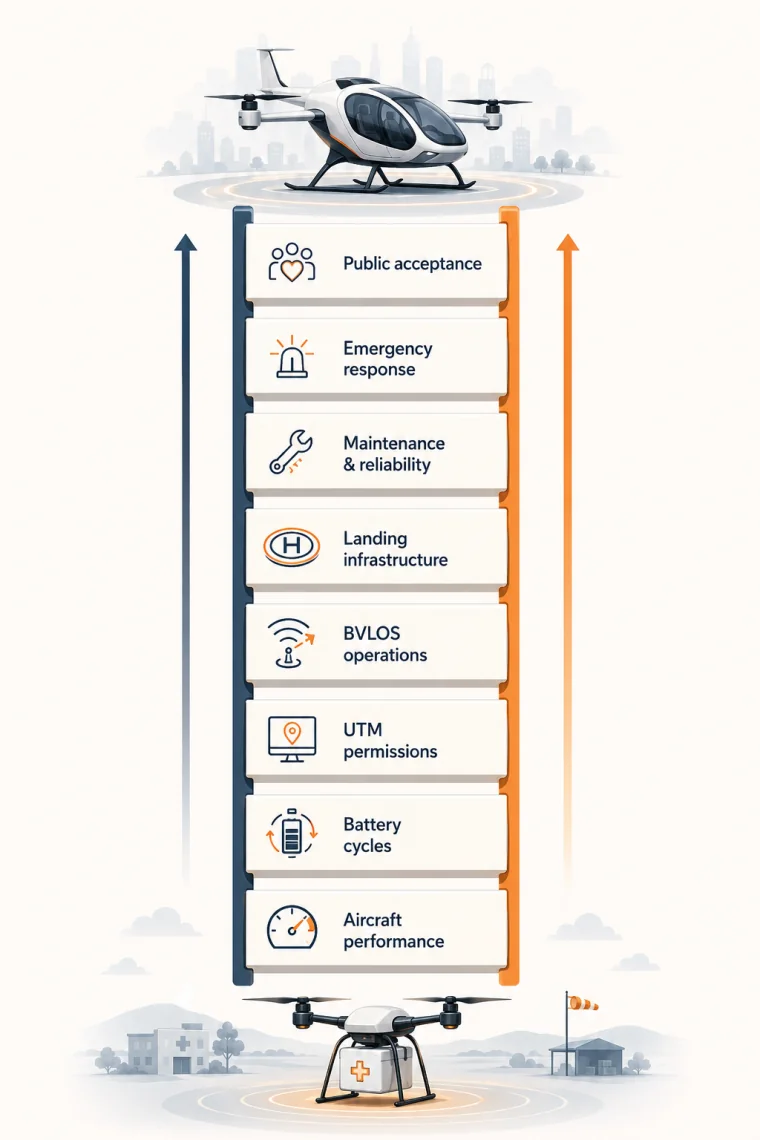
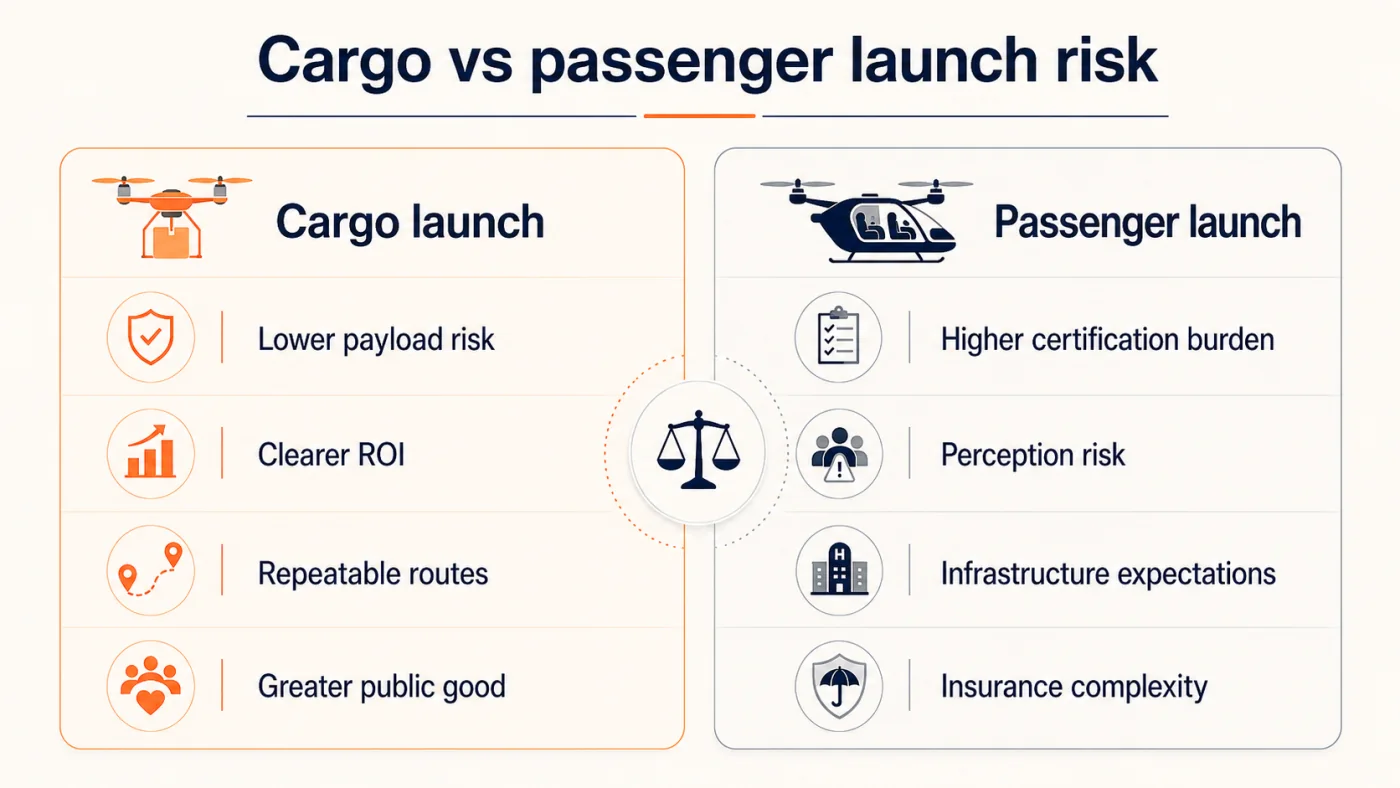
The first serious operational use case for Advanced Air Mobility in India is likely to be logistics and cargo. More importantly, it should be. Cargo is where the technology can prove itself without carrying the reputational, regulatory, and safety burden of passenger flight on day one. It creates a lower-risk path to validate aircraft performance, low-altitude corridors, digital permissions, landing infrastructure, detect-and-avoid systems, battery cycles, ground handling, and public response. In short: cargo is not a side market. It is the proving ground.
This analysis builds on Quogent's published report, Skies Unlocked, which examines AAM airspace integration readiness and the policy systems required for operational scale.
In the report we released last year, Skies Unlocked, we argued that AAM is inevitable, but readiness is optional. India was placed in the "Rising Navigator" cluster and ranked 18th among 25 countries on airspace integration readiness, with solid policy foundations but gaps around dedicated corridors, BVLOS rules, UTM deployment, surveillance, enforcement, and scalable implementation.
The report also identified a point that now looks even sharper: while air taxis get the headlines, drone logistics is already where aerial mobility is delivering visible value. Medical supply delivery, urban e-commerce pilots, postal access for isolated communities, industrial just-in-time logistics, and disaster relief were all called out as early India-relevant use cases. The investor lens was equally clear: freight and logistics can help balance the operating mix while the passenger market matures.
Architecture Needs Operating Data
The latest developments reinforce that thesis. India's July 2025 ICAO working paper says the country is advancing drones and AAM to address transport and logistics needs arising from urbanization and economic growth. It also confirms that DGCA's Drone Directorate has been tasked as the nodal directorate for AAM operations, with six working groups developing requirements across vertiports, VCA type certification, crew licensing, air operator permits, UTM, and MRO.
The same paper identifies sandbox sites in Gujarat and Andhra Pradesh to validate operational models, and proposes dedicated VCA corridors, dynamic airspace allocation, state coordination for vertiport networks, Centres of Excellence, and support for indigenous manufacturing.
That is the right architecture. But architecture needs operating data. Cargo can provide it first.

AAM is not one technology. It is a stack. The aircraft is only the most visible layer. The real operating system includes airspace design, UTM integration, digital permissions, ground nodes, charging or battery swapping, dispatch software, weather decisioning, emergency procedures, maintenance protocols, incident reporting, community acceptance, and commercial demand.
Passenger AAM needs all of these to work at aviation-grade reliability. Cargo allows India to test the same stack with simpler payloads, repeatable routes, lower public anxiety, and faster iteration cycles.
This is why logistics should be treated as India's AAM Phase Zero.
Where The First Corridors Make Sense
The strongest early corridors will not necessarily be the most glamorous. They will be the ones with a hard business case. Hospital-to-lab sample movement. Blood and organ logistics. Cold-chain pharmaceutical delivery. Airport cargo to city distribution nodes. Port-to-warehouse movements. Factory-to-supplier emergency parts runs. Flood, landslide, and disaster-response routes. Dense e-commerce clusters where road travel time is unpredictable and every minute of SLA compression has value.
Bengaluru is already showing what this looks like in practice. Narayana Health and Airbound announced the completion of more than 700 medical drone flights in Bengaluru, while local reporting noted that the pilot moved diagnostic samples across a 4 km aerial route in around 10 minutes, compared with nearly an hour by road during peak traffic. Each flight could carry up to 40 diagnostic samples. This is exactly the type of proof point India needs: not a futuristic demo, but a repeatable operational corridor solving a real logistics pain point.
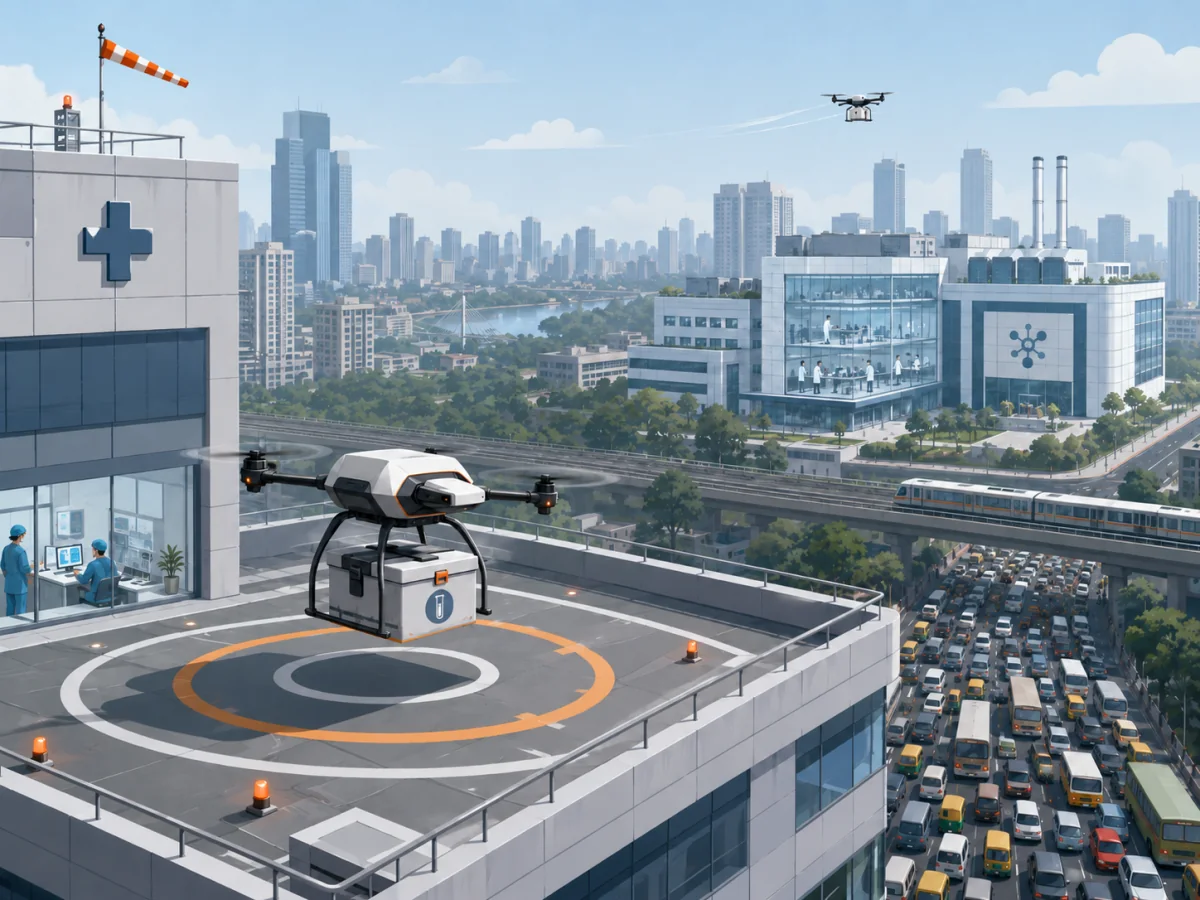
Andhra Pradesh is also emerging as a serious testbed. Airbound's partnership with Andhra Pradesh Drone Corporation reportedly targets a scalable drone delivery network across the Amaravati Capital Region, connecting Amaravati, Vijayawada, and Guntur through dedicated drone corridors, with an ambition to enable up to 10,000 daily drone flights. Whether that target is achieved on schedule is less important than the direction of travel: state-level aerial logistics networks are moving from concept note to operating plan.
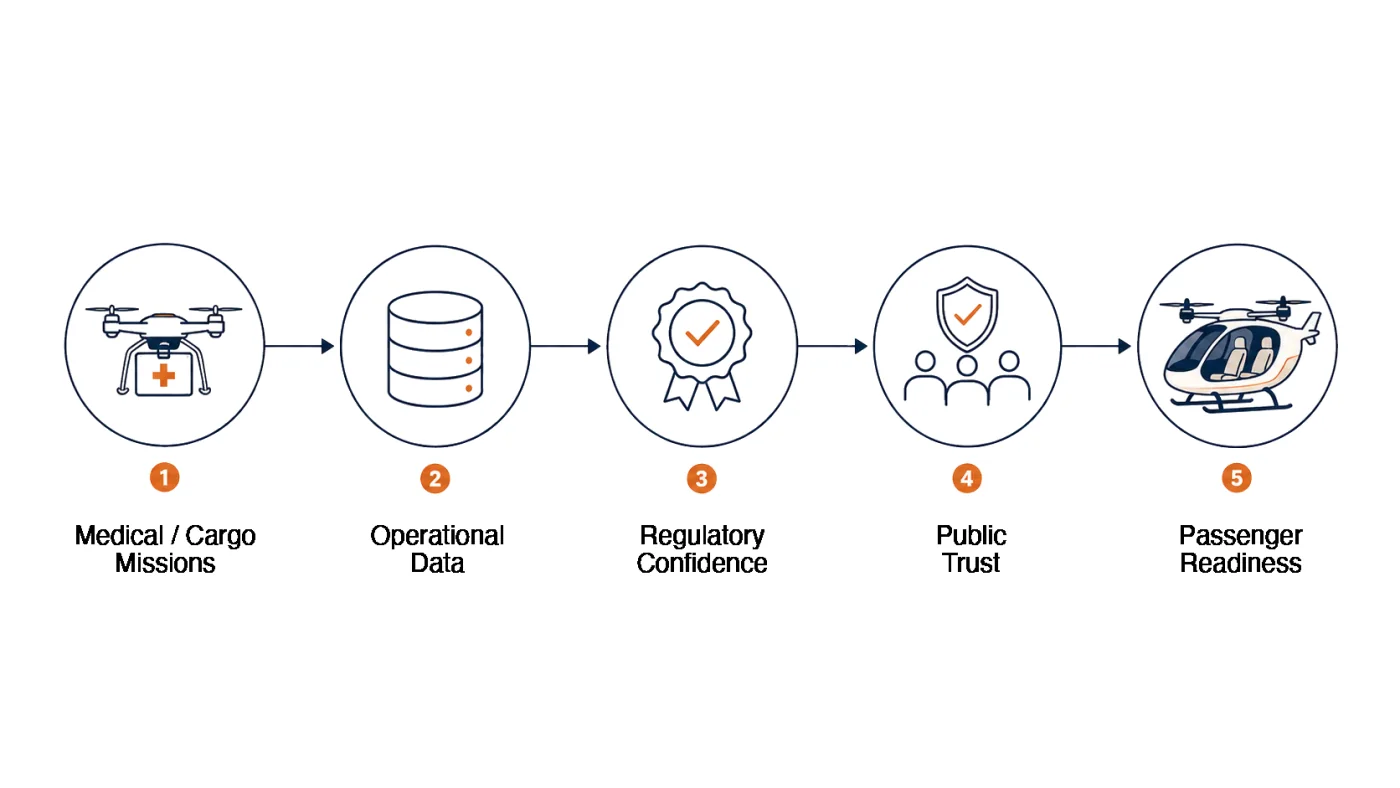
This is the trust flywheel India needs. Start with high-utility cargo missions. Generate operating data. Use that data to strengthen safety cases. Use safety cases to refine regulation. Use repeated, visible, socially useful operations to build public confidence. Then expand toward heavier cargo, emergency response, airport logistics, and eventually passenger operations.
Public Value Before Premium Mobility
The public acceptance logic is especially important. Passenger air taxis risk being perceived as premium mobility for the few. Medical logistics and emergency cargo do the opposite. They frame AAM as public value: faster diagnostics, better rural access, more resilient disaster response, reduced congestion pressure, and improved service reach.
A drone carrying a blood sample or vaccine cooler is not a luxury symbol. It is a credibility asset.
The policy ecosystem is beginning to converge around this sequencing. CII's 2026 report on AAM in India, released at the Ministry of Civil Aviation, examines a Gurugram-Connaught Place-Jewar Airport corridor but explicitly sets out a phased roadmap beginning with high-social-impact missions such as medical logistics and air ambulance services. Sarla Aviation's 2026 updates also show the wider ecosystem forming around aircraft testing, vertiport infrastructure, and medical transport partnerships, including work with Cochin International Airport and healthcare stakeholders.
This is how markets mature: not by waiting for the perfect air taxi launch, but by accumulating credible operations.
The Five-Move Playbook
For India, the cargo-first playbook should have five moves.
- Designate logistics corridors before passenger corridors. These should connect hospitals, labs, airports, ports, industrial clusters, warehouses, emergency response depots, and high-density e-commerce zones. The corridors should be narrow, measurable, and mission-led, not abstract.
- Make BVLOS the regulatory unlock. India's current foundation - Drone Rules 2021, Digital Sky, green/yellow/red zones, and the National UTM Policy - has created a workable starting point for low-altitude aviation. Cargo corridors can provide the controlled environment to graduate BVLOS from exemption-led pilots to repeatable commercial permissions.
- Build logistics vertiports, not just passenger vertiports. The first infrastructure layer should be modular droneports on hospital rooftops, lab campuses, warehouse roofs, industrial parks, airports, and logistics parks. These nodes need secure payload transfer, cold-chain handling, charging, fire safety, digital identity, and automated dispatch. They do not need lounge architecture.
- Mandate data-sharing from every sandbox. Each cargo pilot should produce a standardized dataset: route reliability, weather aborts, noise, battery performance, maintenance events, lost-link incidents, landing accuracy, ground handling time, detect-and-avoid performance, community complaints, and cost per trip.
- Use cargo to localize the industrial stack. India's AAM opportunity is not only operating aircraft; it is building the components of a domestic aerial mobility supply chain. Batteries, avionics, propulsors, composite structures, charging equipment, fleet software, UTM systems, MRO, ground infrastructure, and training can all develop around logistics networks before passenger AAM reaches scale.
The Real Unlock
The strategic implication is simple: passenger AAM should not be delayed; it should be de-risked. Cargo gives regulators, operators, investors, and the public a way to see the system work before the stakes rise. It converts AAM from a speculative mobility promise into a repeatable infrastructure service.
India's best route to AAM leadership is not to copy the global race for air taxis. It is to build a uniquely Indian deployment sequence: medical logistics first, critical cargo next, industrial and e-commerce corridors after that, and passenger services once the operating stack has earned trust.

The sky will become infrastructure. But infrastructure is trusted only when it works every day, not when it performs once at a showcase. Cargo can make AAM boring in the best possible way: reliable, useful, priced, regulated, and repeatable.
That is the real unlock. Before India flies people over traffic, it should fly the things that prove the system is ready.