 uogent
®
uogent
®
Analysis / Rare Earths & Industrial Strategy
A Cooperative Rare-Earth Cluster to Unlock the Next Phase of India’s Industrial Strategy
A practical architecture for connecting India’s geological base, regional corridors, shared capabilities, and independently operated commercial plants into a customer-qualified manufacturing system.
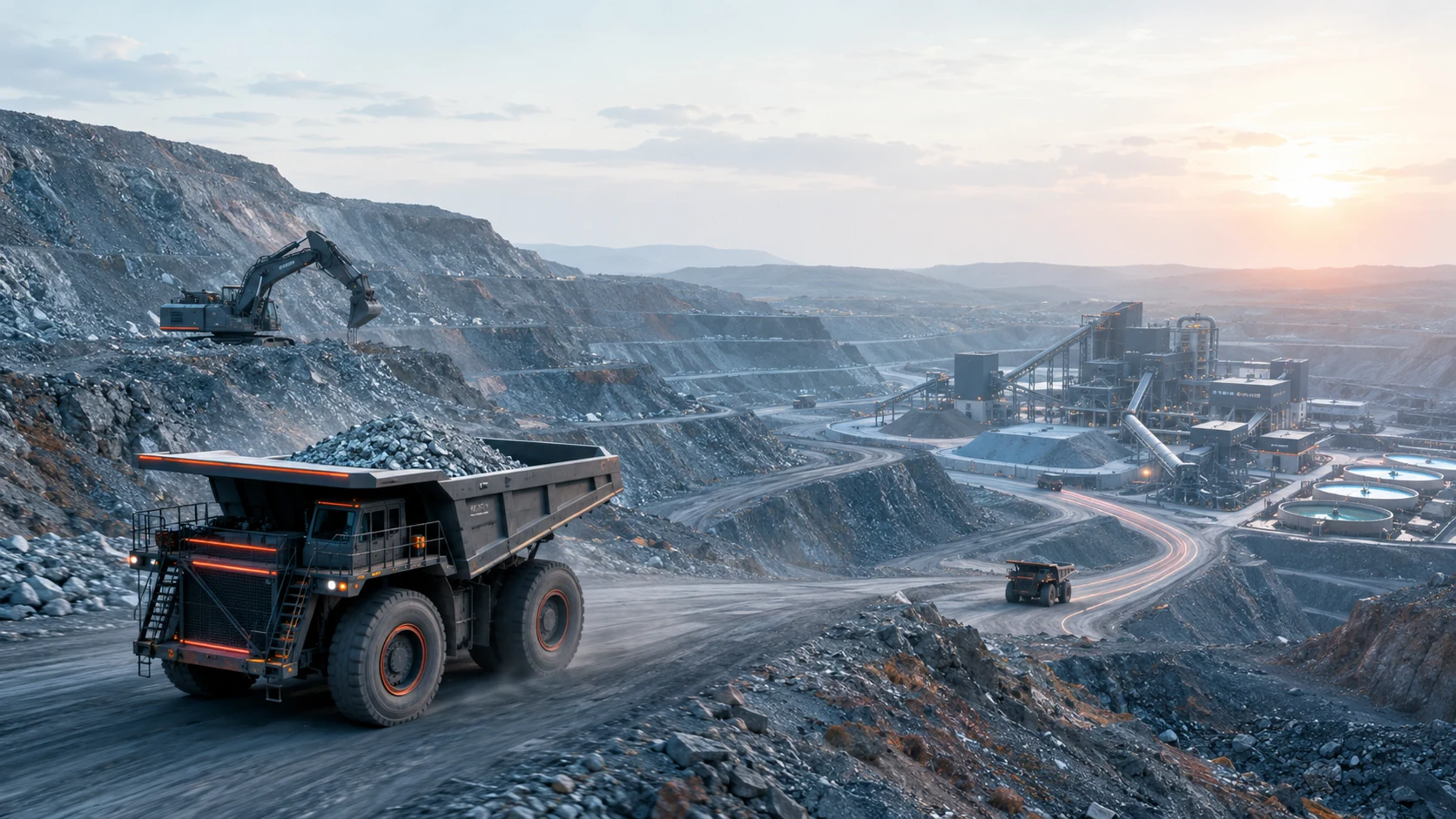
India’s rare-earth sector brings together a substantial geological inventory, established mineral-sands operations, chemical-processing capability, public research institutions and some of the world’s largest emerging markets for electric mobility, renewable energy, electronics, advanced manufacturing and strategic systems.
The next phase is to connect these strengths into an integrated industrial platform capable of converting legally deliverable feedstock into metals, alloys, magnets and customer-qualified components. The proposed cooperative cluster offers an architecture for making that transition: a nationally coordinated network of complementary regional nodes, shared public-interest infrastructure and independently operated commercial plants.
This model is relevant beyond rare earths. It demonstrates how India can pursue modern industrial strategy by combining national coordination with competitive enterprise, shared capabilities with clear accountability, and domestic manufacturing with diversified international partnerships. It also offers a repeatable method for coordinating multi-state value chains with advanced technical and regulatory requirements.
Rare Earths Are a Family of Specialised Markets
“Rare earths” describes 17 chemically related elements: the 15 lanthanoids, plus scandium and yttrium. Their similar chemistry means they often occur together and require sophisticated separation. Their different physical properties, however, support distinct applications and markets.
Neodymium and praseodymium are central to high-performance neodymium–iron–boron, or NdFeB, magnets. Dysprosium and terbium can enhance magnet performance at elevated temperatures. Samarium supports samarium–cobalt magnets used in demanding aerospace, defence and atomic-energy applications. Cerium and lanthanum serve catalysts, polishing, glass and other industries. Other rare-earth elements enable optical communications, medical imaging, lasers, ceramics and specialised electronics.
Industrial strategy therefore works best at the level of a defined product and value-chain stage. A rare-earth resource, mineral concentrate, separated oxide, metal, alloy and finished magnet each represents a different commercial product. Customer qualification adds another stage because automotive, wind, aerospace and defence users approve a specific material, production process, geometry, coating and performance envelope.
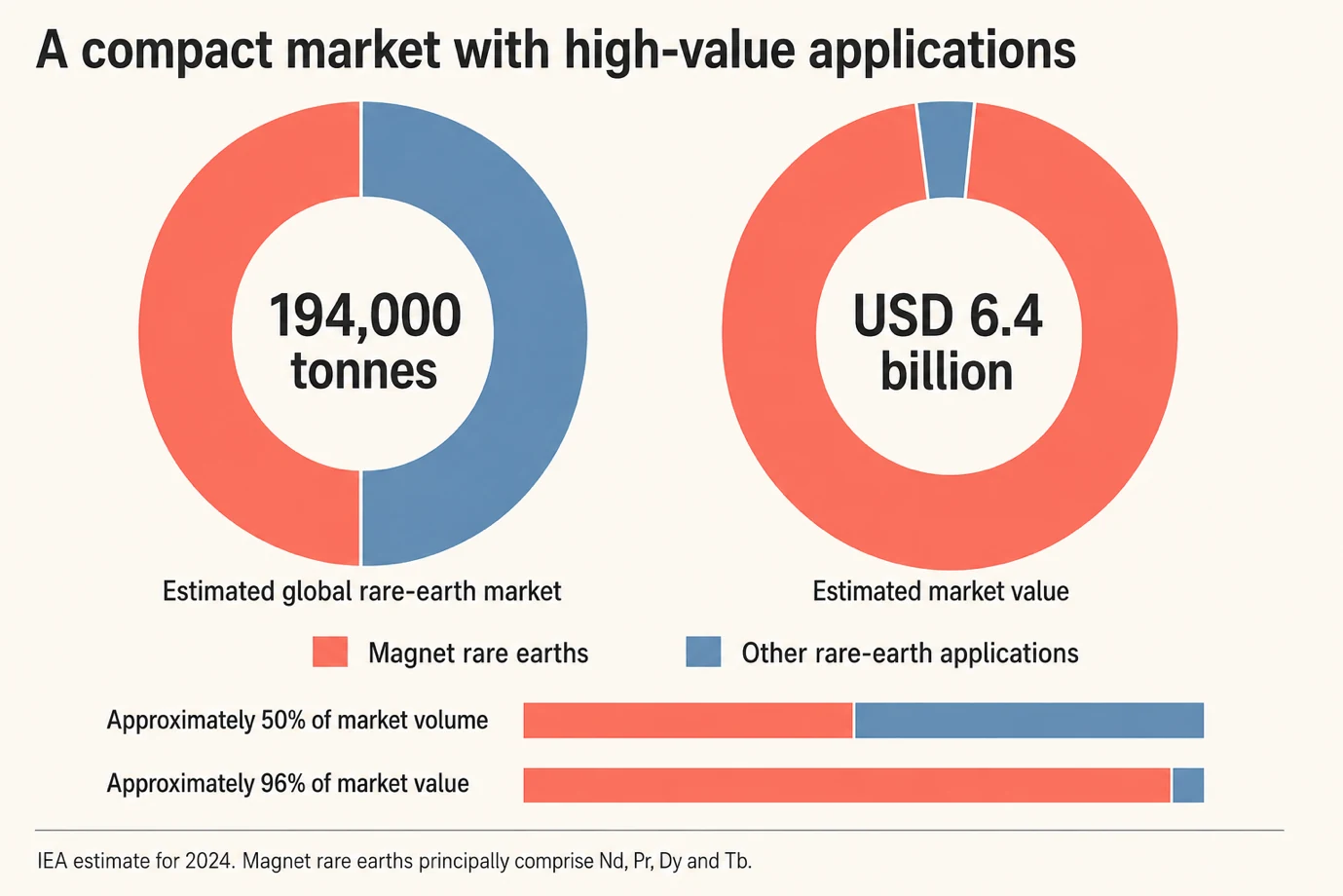
The sector is relatively small in tonnage yet significant in economic reach. The International Energy Agency estimates that the 2024 rare-earth market was about 194,000 tonnes and USD 6.4 billion. Magnet rare earths represented roughly half of volume and approximately 96% of value. These materials enable systems whose economic contribution extends far beyond the value of the mineral input.
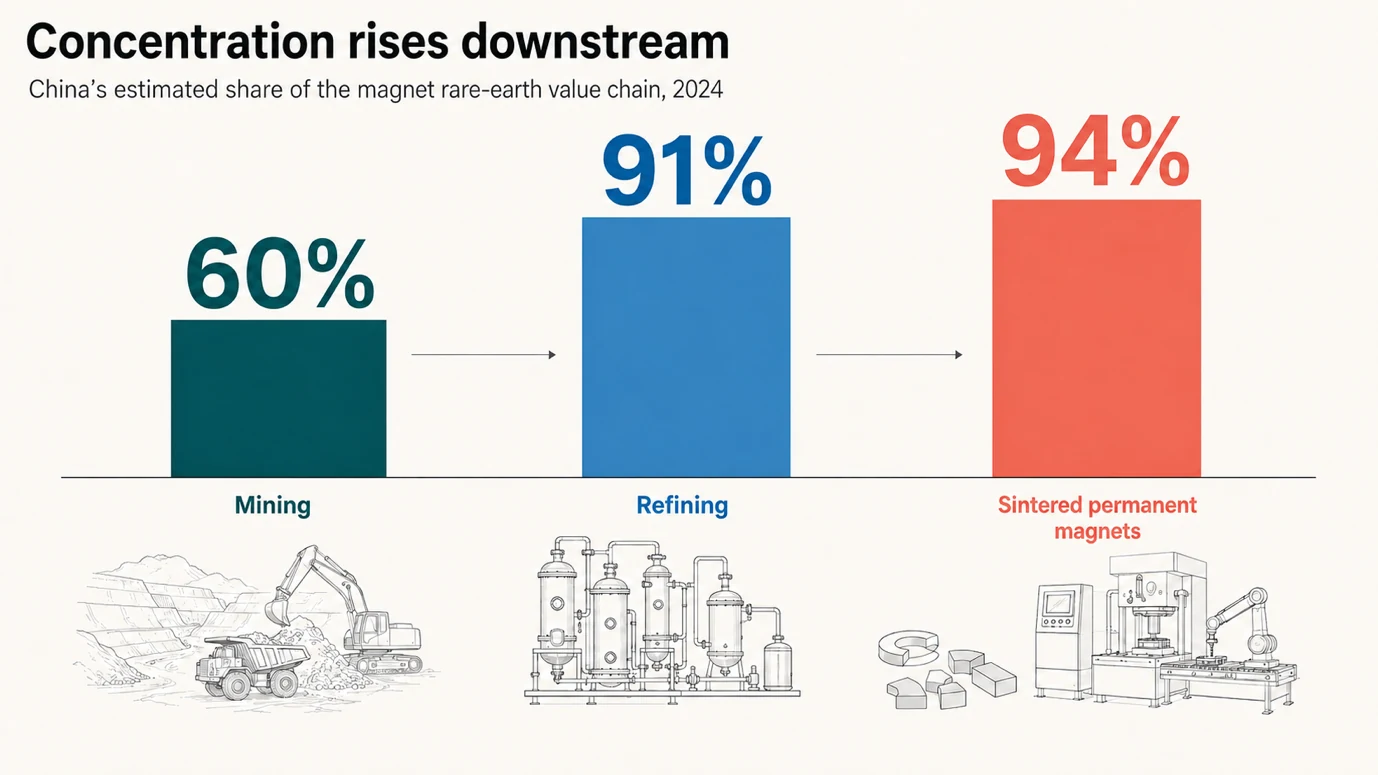
Global activity also becomes increasingly concentrated at successive stages. On a matched magnet-rare-earth basis, China accounted for approximately 60% of mining, 91% of refining and 94% of sintered permanent-magnet production in 2024. This creates strategic value in building diversified separation, metallisation, alloying, magnet-manufacturing and qualification routes.
India Begins From a Broad Base of Resources and Capabilities
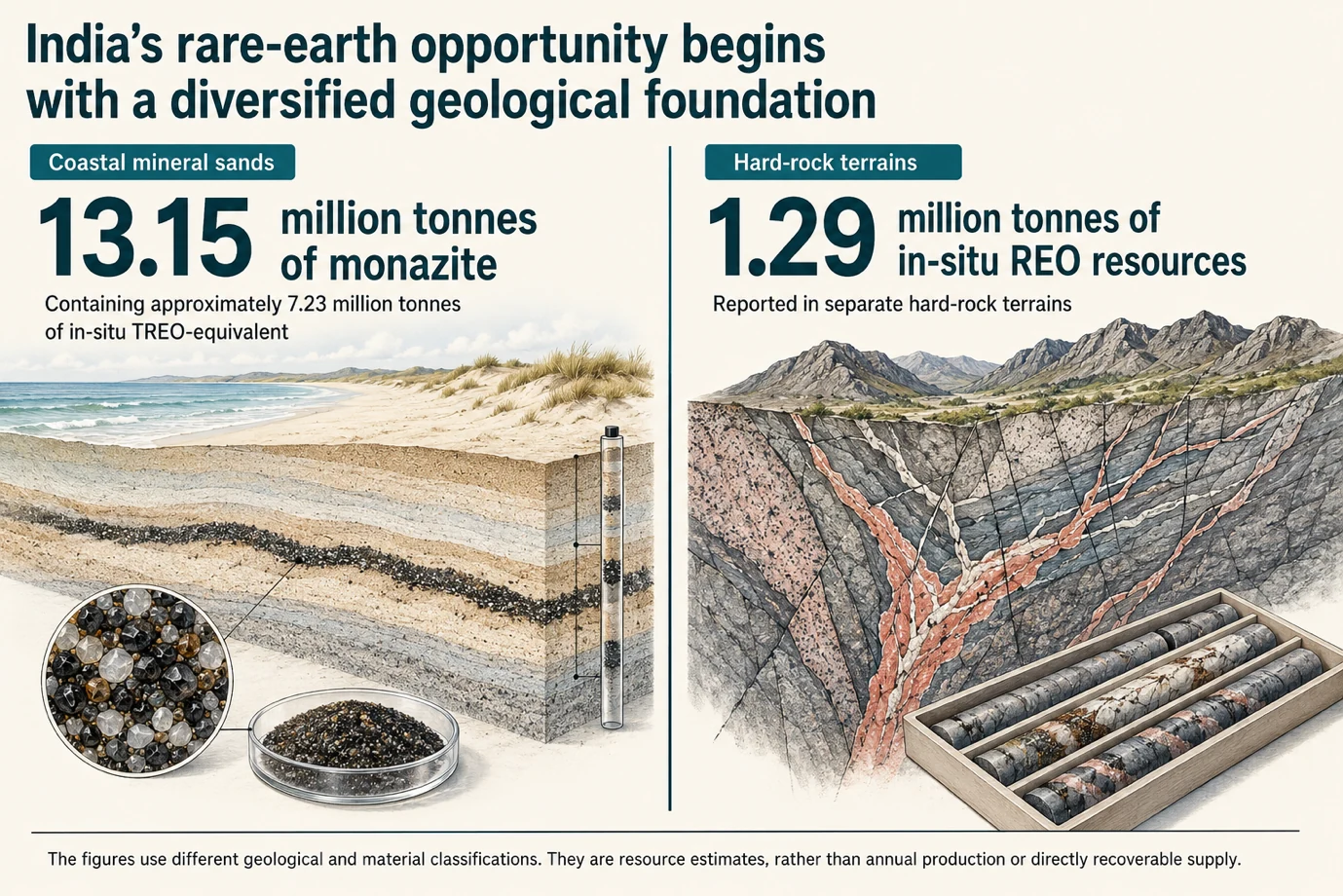
India’s official geological inventory includes 13.15 million tonnes of monazite containing about 7.23 million tonnes of in-situ total-rare-earth-oxide equivalent. A further 1.29 million tonnes of in-situ rare-earth-oxide resources is reported in hard-rock terrains. These figures provide a substantial basis for exploration, process development and project selection, with each resource progressing through its appropriate technical, environmental, legal and economic assessments.
India also has operating capabilities across several parts of the chain. IREL manages mineral-sands assets and a mixed rare-earth-chloride plant with stated nameplate capacity of 11,200 tonnes per year. Aluva has capability in selected high-purity products. India’s specialist samarium–cobalt facility provides a platform for strategic applications and further qualification-led development. Public laboratories and pilot facilities add expertise in separation, metals, alloys, magnets and recycling.
The ₹7,280-crore rare-earth permanent-magnet programme creates a pathway for the next stage of manufacturing. It targets 6,000 tonnes per year of integrated sintered NdFeB capacity. The request for proposals estimates an associated requirement of approximately 2,000 tonnes per year of NdPr oxide and provides for an optional aggregate IREL allocation of up to 500 tonnes per year for L1–L3 beneficiaries under future commercial agreements. Beneficiaries would arrange the remaining feed through their chosen domestic and international supply strategies. At the report’s 13 July 2026 cut-off, the programme was in the procurement stage.
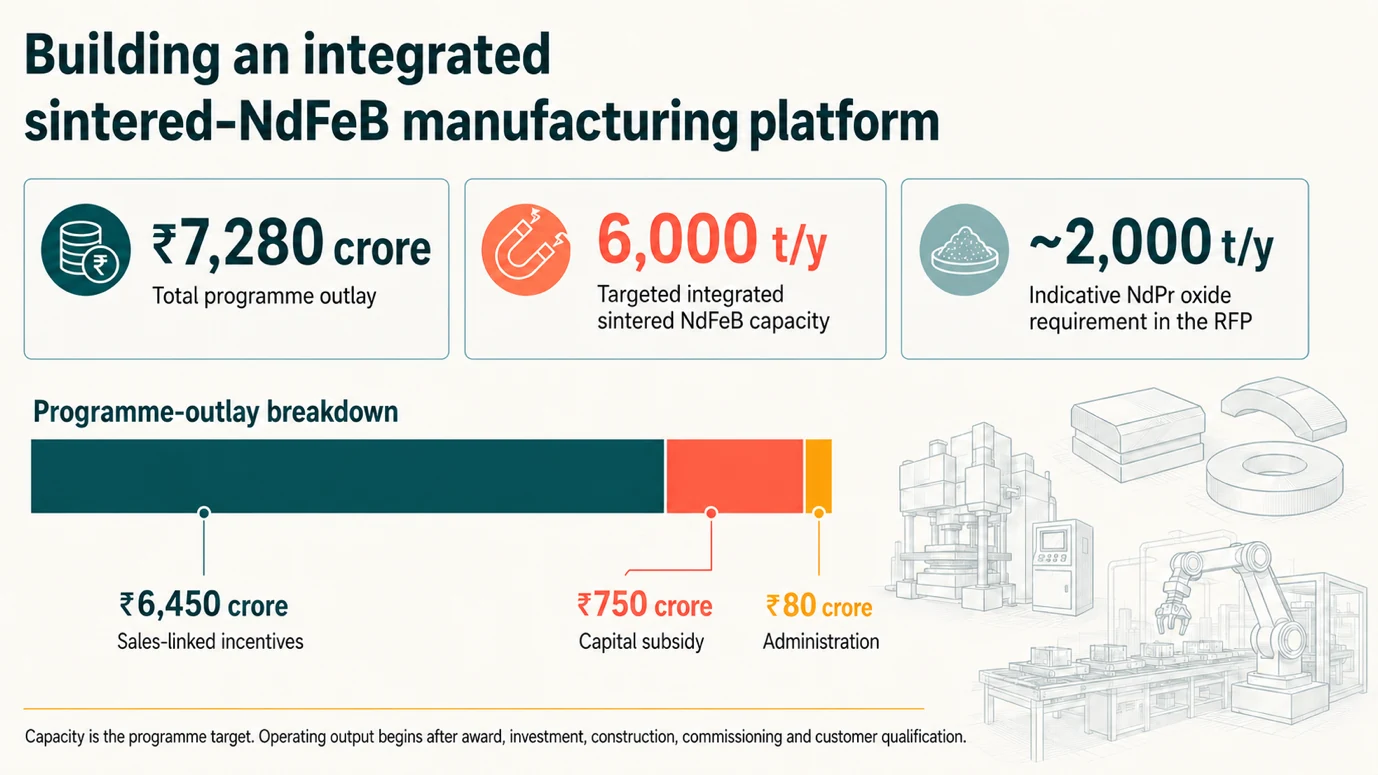
Together, these elements establish the foundations for a coordinated industrial system linking feed, technology, operating expertise, utilities, environmental management, customers and finance.
The Proposed Architecture: Cooperate at Interfaces, Compete in Markets
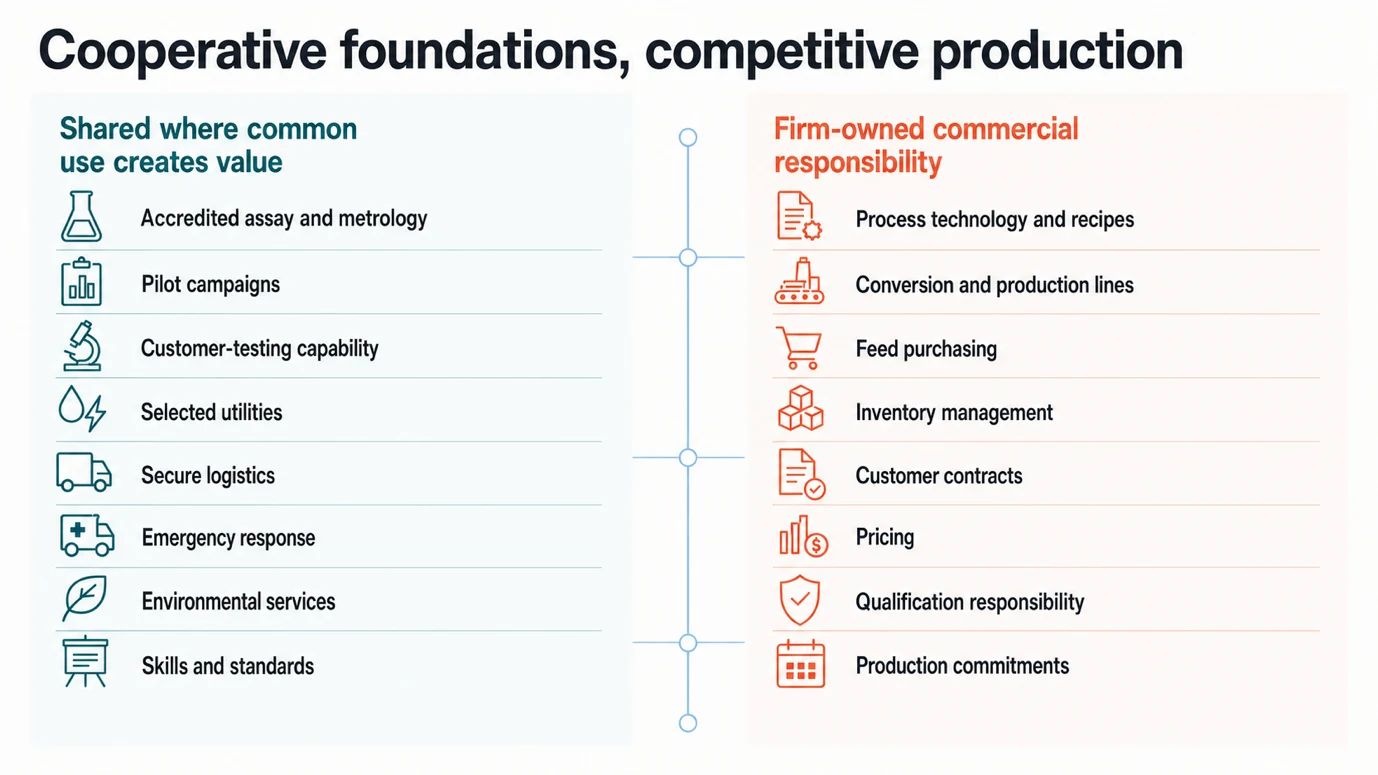
The cooperative cluster model is built around a practical division of roles. National and shared institutions coordinate the interfaces that benefit the system as a whole, while independent firms retain responsibility for technology, production, customers and commercial performance.
The architecture has four layers.
First, a national delivery compact would establish common product definitions, evidence standards, qualification protocols and interfaces between India’s proposed rare-earth corridors. The compact can operate within the National Critical Mineral Mission’s existing governance structure, giving the sector a unified delivery mechanism.
Second, shared-asset arrangements would provide infrastructure that supports several producers and research partners. Potential assets include accredited assay and metrology laboratories, pilot equipment, customer-testing facilities, selected utilities, secure storage, emergency-response capability, workforce programmes and environmental systems.
Third, a neutral service operator could administer shared infrastructure where demonstrated multi-user demand supports one. Its responsibilities would include access, tariffs, scheduling, confidentiality and appeals. Clear operating rules would give large and emerging firms confidence that common assets are available on transparent terms.
Fourth, independent firms would own and operate commercial conversion, alloy, magnet and component lines. They would control process knowledge, customer relationships, pricing and production decisions while carrying their defined operating and market responsibilities.
This structure combines economies of coordination with the discipline of competition. Shared laboratories, utilities, training and emergency services can reduce duplicated investment and accelerate learning. Firm-owned process trains preserve technology differentiation, customer accountability and the incentives required for continual improvement.
Complementary Corridors Can Form One National Production Network
The four announced rare-earth corridors can serve as specialised nodes within the cooperative cluster. The report identifies preliminary functional archetypes: upstream and wet chemistry in Odisha; separation and refining in Kerala; port-linked technology and strategic capability in Andhra Pradesh; and downstream manufacturing and customer-qualification adjacency in Tamil Nadu.
These archetypes provide a starting point for competitive evaluation. Final mandates and locations would follow evidence on feed availability, utilities, environmental capacity, logistics, customer access, technology and workforce capability. Each node can specialise where it offers the strongest whole-system contribution, while common standards allow material and information to move reliably across the network.
The model also treats feed coordination as both a commercial and information challenge. A common material ledger would record source, ownership, assay, mineralogy, impurities, radionuclide information where relevant, custody, specification, delivery status and contingency arrangements. Physical blending would follow demonstrated compatibility. Product, conventional-waste, hazardous-waste and radiological streams would remain separately attributable throughout the chain.
This approach creates a national operating picture while preserving the legal and commercial identity of each material stream.
A Conceptual Two-Campus Pilot Construct
The proposed first step is a focused, gated pilot organised around a specific commercial objective: a customer-qualified chain from NdPr oxide to metal, alloy and sintered NdFeB magnet.
Campus A would concentrate on regulated feed and chemistry. It would receive and characterise material, conduct representative process campaigns, manage chemical and radiological interfaces, and produce qualified intermediates with verified residue destinations. Existing regulated capabilities could be incorporated wherever they strengthen delivery.
Campus B would focus on clean advanced materials and customer qualification. Located close to downstream markets and technical skills, it would convert oxides into metals and alloys, manufacture magnets and components, recover production scrap and host customer-facing testing.
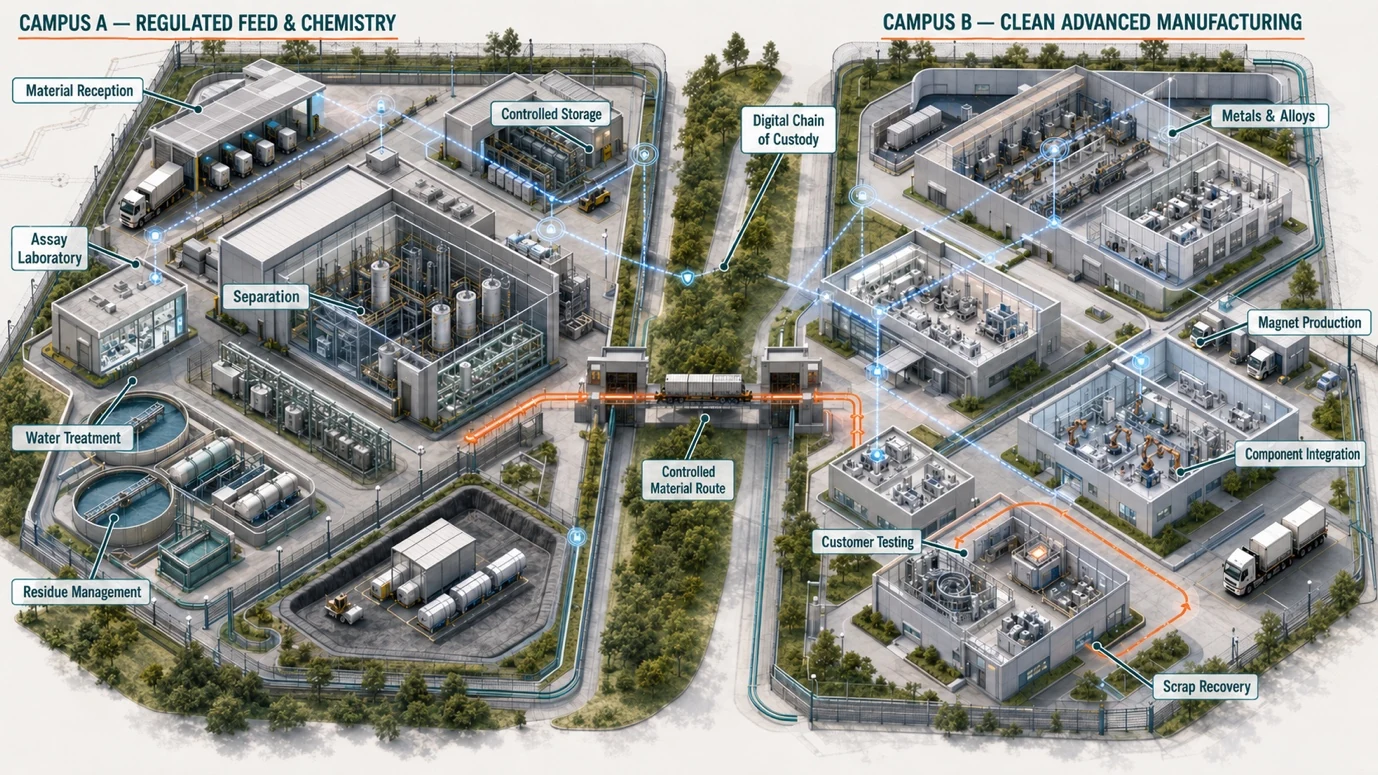
The two-campus concept offers a way to separate higher-burden chemistry from clean manufacturing while creating a close connection between producers and customers. Its whole-system performance can be assessed alongside brownfield, single-campus and more distributed configurations. The preferred architecture would emerge through comparison of cost, schedule, permitting, logistics, accountability and continuity.
Five evidence gates would guide the release of capital and the transition between stages.
- Feed: contracted, specification-matched supply supported by a documented continuity plan.
- Technology: representative testwork, reconciled balances, a defined scale-up basis, critical-equipment access and trained operating talent.
- Customer: exact product grades, sample and qualification plans, acceptance milestones and a credible route to contracted demand.
- Safeguards: permits mapped to the relevant legal person, site, activity and material; authorised destinations; emergency readiness; closure capacity and financial assurance.
- Full funding: equity, debt, public support, working capital, ramp expenditure, qualification costs and lifecycle obligations financed as one programme.
These gates create a shared language for government, investors, producers, regulators and customers. They also ensure that technical progress, commercial readiness and public support advance together.
Clear Ownership Can Turn Coordination Into Delivery
The Ministry of Mines, working through the National Critical Mineral Mission’s empowered committee and secretariat, would integrate the portfolio and maintain authoritative product, project and risk ledgers. The Department of Atomic Energy would coordinate policy at atomic-mineral interfaces. IREL would manage its contractual and operating feed obligations. The Ministry of Heavy Industries would administer the magnet programme and clarify the treatment of shared assets. User ministries would translate strategic demand into specifications and qualification-backed procurement. States would coordinate sites and utilities, while regulators would retain independent licensing, control and enforcement functions.
The delivery compact would track each project through distinct stages: announcement, tender, award, financial close, construction, commissioning, first product, customer qualification and sustained commercial operation.
During the first 24 months, the priority would be to establish the compact, publish the feed ledger and corridor interfaces, run representative testwork, evaluate locations and architectures, secure technology and equipment plans, and translate customer requirements into specifications and contracts. Years three to five would focus on commissioning, repeated customer qualification, Indian operating capability, production-scrap recovery and independent performance assurance. Years five to ten would provide the opportunity to expand proven modules and add selected heavy-rare-earth, specialist-magnet and end-of-life recycling capabilities.
A Model for Modern Industrial Strategy
The cooperative cluster is designed for selective resilience within an interconnected global economy. India can combine domestic feed and processing with international sources of selected heavy rare earths, specialised equipment, technology, finance and customer relationships. Diversified partnerships become part of the industrial architecture.
Progress can be measured through customer-qualified tonnes and repeat batches; yield, uptime and recovery; contracted feed coverage; continuity following the loss of one critical route; verified product and residue destinations; safety and compliance; Indian operating capability; and public support per qualified kilogram. Geological additions, approved investment and nameplate capacity provide important context, while these operating measures show the system’s industrial contribution.
India’s rare-earth opportunity can therefore be understood as an institution-building and manufacturing opportunity as much as a mineral opportunity. The decisive asset is a governed network that connects legally deliverable feed, advanced processing, competitive producers, skilled teams and demanding customers.
By coordinating common interfaces and preserving enterprise-level responsibility, the proposed cooperative cluster can unlock the sector’s next phase - and offer a practical template for India’s wider modern industrial strategy.