 uogent®
Analysis / Power Systems & Grid Modernisation
Draft NEP 2026: The Grids Evolution as a Platform
The draft brings future power planning, fast grid support, local energy resources, consumer choice and digital payment into one policy. The challenge is to make those parts work as one accountable system.

India’s last electricity-policy era focused on connection and capacity: connect villages, add power plants, build transmission and expand local networks. Those tasks continue. But the next challenge is coordination. A grid with more solar and wind, batteries, rooftop systems, electric vehicles and factories that can shift their electricity use has more decisions to make - often closer to real time.
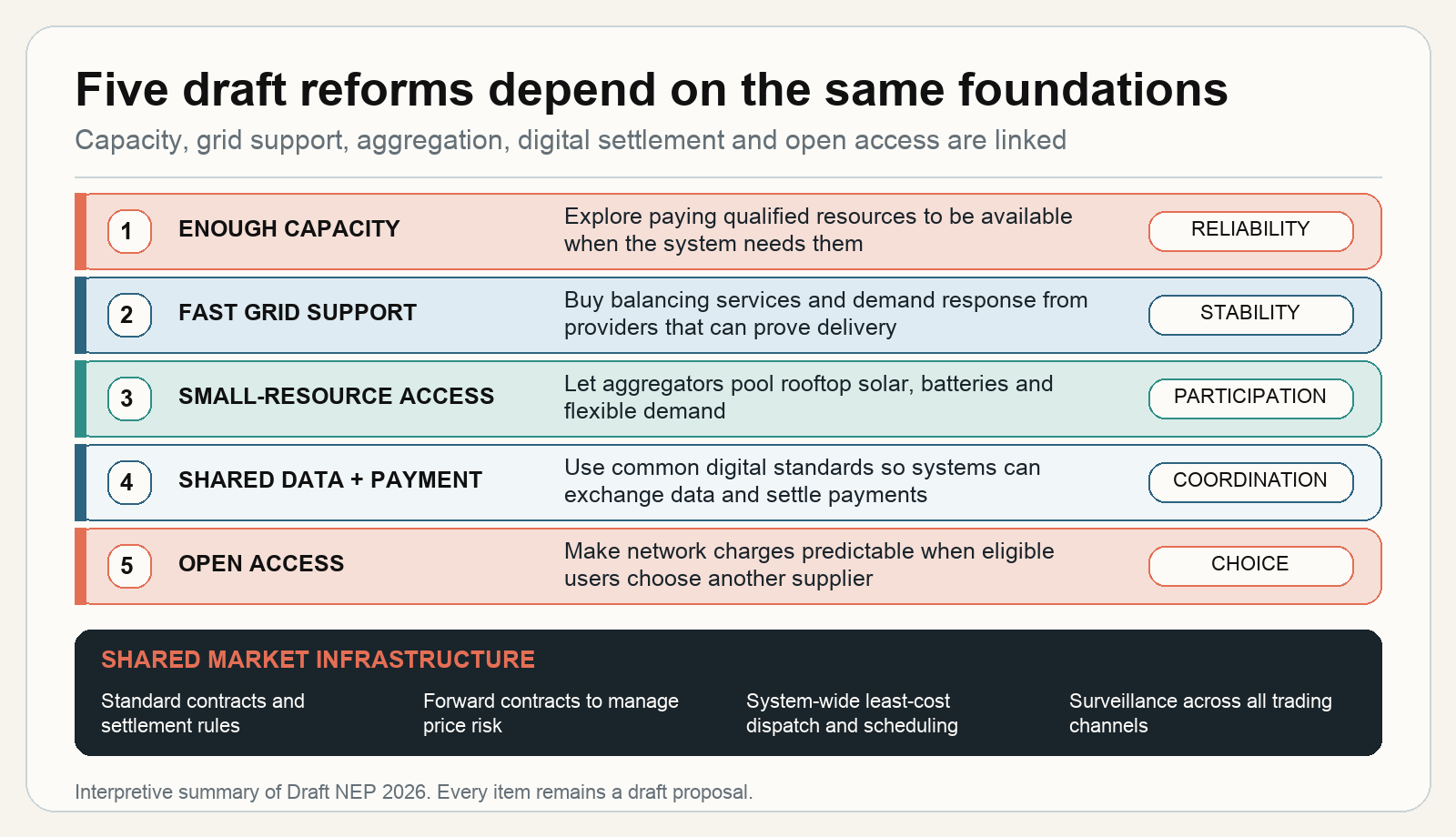
The Draft National Electricity Policy 2026 brings together reforms that are usually discussed separately. Resource adequacy means planning enough dependable supply and flexible demand for future needs. A capacity market would pay a qualified resource for being available when needed, not only for electricity produced. Ancillary services are fast actions that help keep the grid stable. Aggregators would combine many small resources so they can participate as one. The India Energy Stack would provide common digital standards for exchanging data and settling payments.
None of this is settled. The policy was circulated for consultation in January 2026 and remains a draft. It asks the Central Electricity Regulatory Commission (CERC), the national regulator for interstate electricity trade and many national market rules, to study a capacity market in phases; it does not create one. The India Energy Stack is a proposal for shared standards, not a finished system. Different state rules, late payments and unclear responsibilities could still produce systems that do not work together.
The grid is becoming harder to coordinate
Electricity has always required coordination, but responsibility once followed a simpler chain. Generators produced power; the transmission grid moved it over long distances; distribution companies, or DISCOMs, delivered it locally and billed customers. That model worked best when a small number of large plants supplied most electricity under long contracts. It is less suited to millions of rooftop panels, batteries, vehicles and flexible users whose value changes by place and by minute.
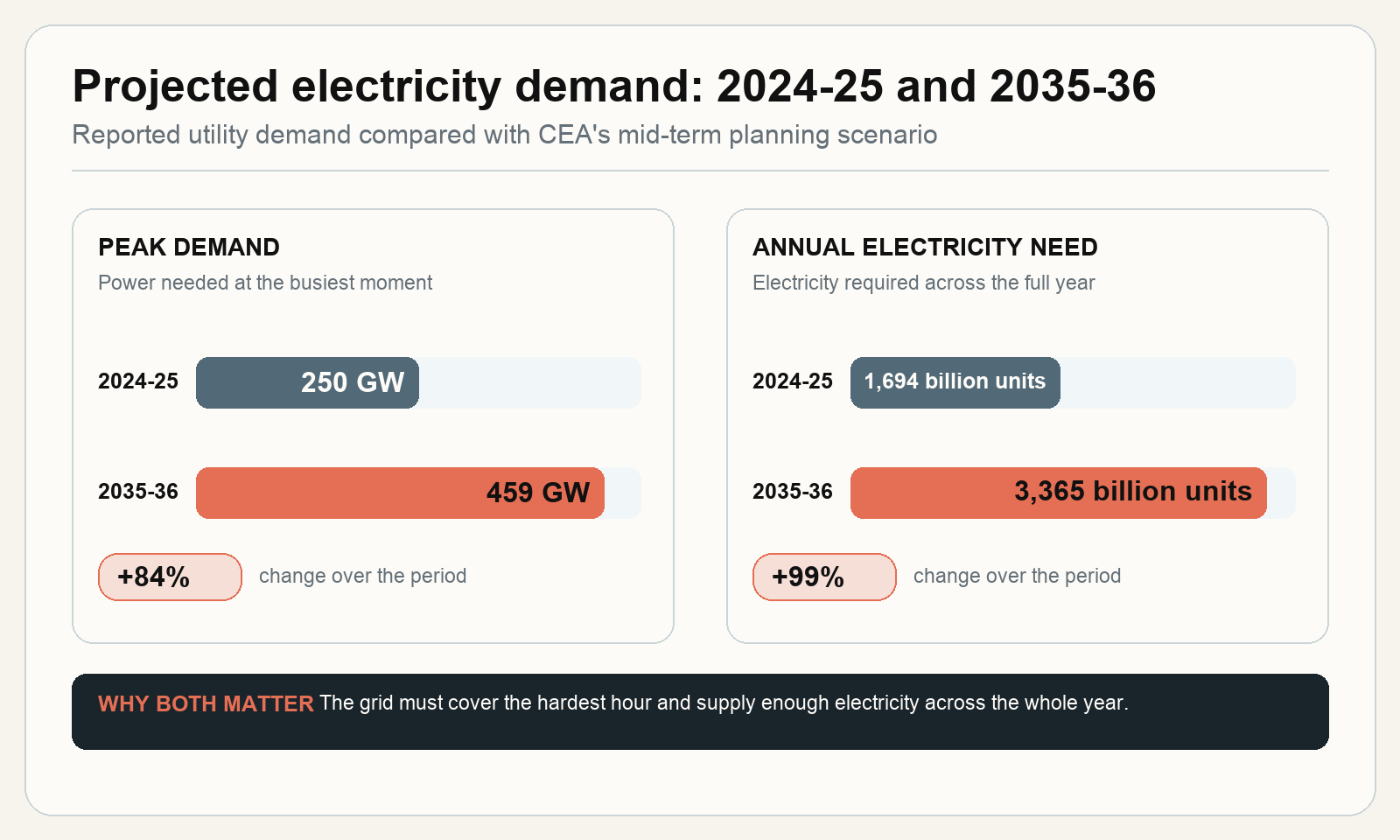
Scale makes that coordination task more urgent. The Central Electricity Authority (CEA), India’s national technical and power-planning body, projects peak demand of 459 gigawatts in 2035-36, up from about 250 gigawatts in 2024-25. It expects annual electricity needs to rise from about 1,694 to 3,365 billion units - almost double. One unit equals one kilowatt-hour. Planning must cover both the busiest hour and the full year.
The draft calls for reliability plans at national, state and utility level. It proposes time-of-use prices, better visibility of local resources and a distribution system operator (DSO) - a function inside the DISCOM that would coordinate flows and constraints on the local network. In simple terms, planners identify the need, buyers contract for a response, grid control rooms call on it, and shared data systems confirm delivery and trigger payment.
Flexibility becomes something the market can buy
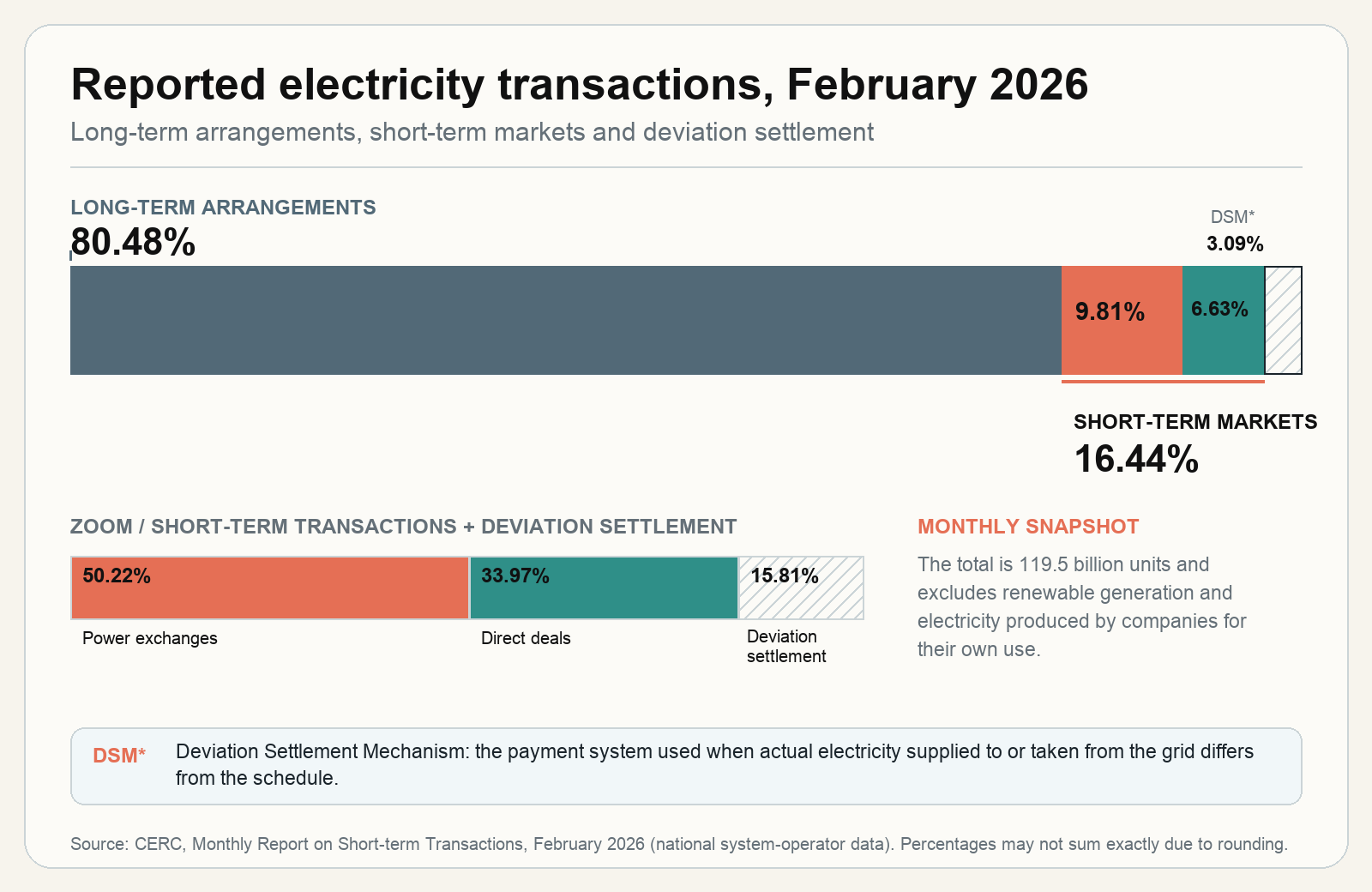
In February 2026, long-term arrangements covered 80.48% of the electricity volume reported by CERC. Power exchanges - central electricity marketplaces - accounted for 9.81%; direct buyer-seller deals, 6.63%; and the Deviation Settlement Mechanism (DSM), 3.09%. DSM settles the gap between scheduled and actual grid use; it is not a voluntary trade.
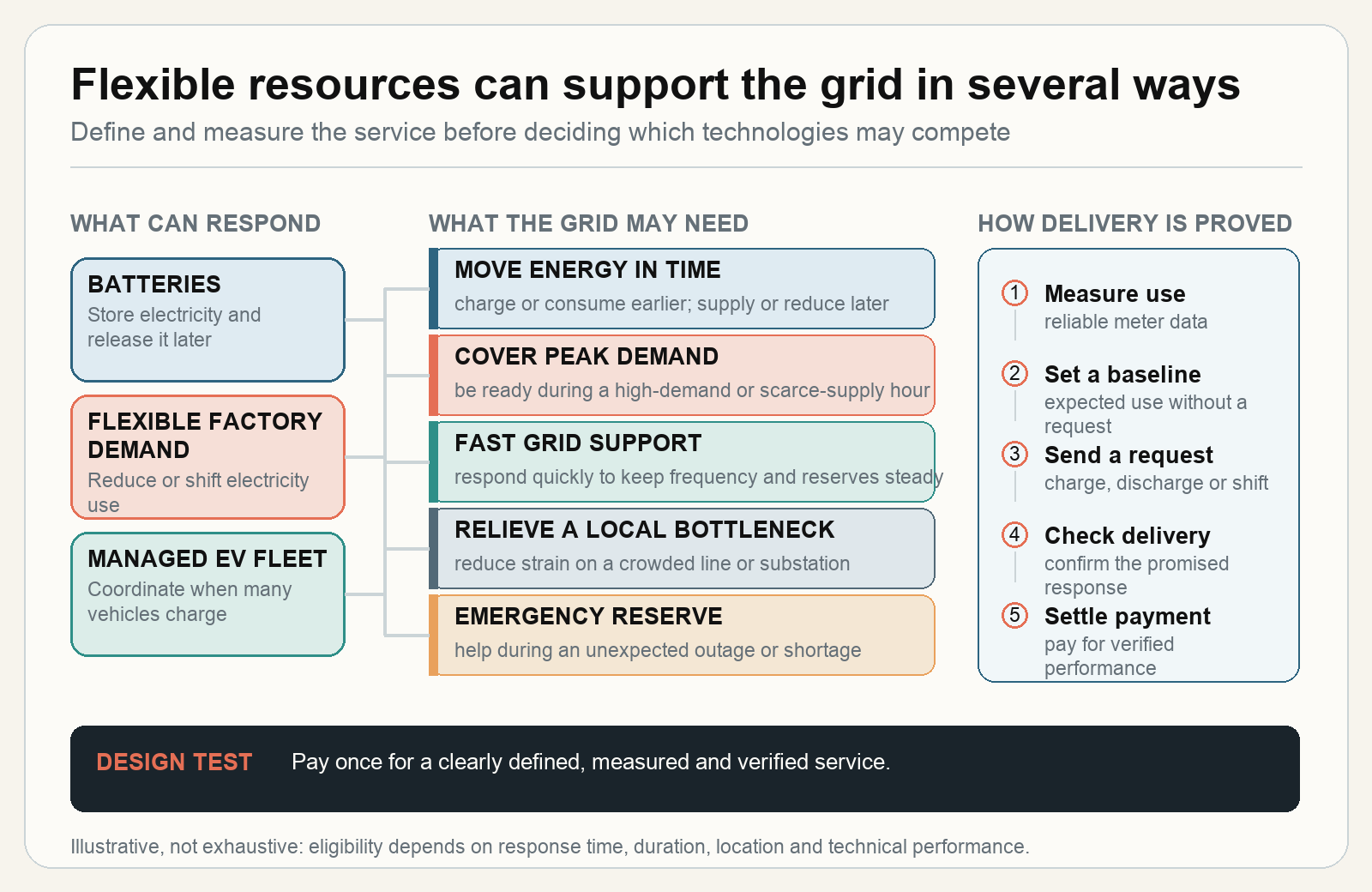
Long-term contracts have financed power plants and protected buyers from sharp price swings. They still matter. But a grid with more solar and wind must also pay for services that keep it reliable. A capacity market would pay for future availability. Ancillary services pay for fast actions that keep frequency and reserves steady. Demand response pays users to reduce or shift consumption when the system is under stress.
The draft supports standard contracts, agreements made ahead of delivery to manage price risk, and wider participation by storage and demand response. Existing CERC ancillary-service regulations already allow qualifying storage and demand response, so the policy is not starting from zero. The larger task is to connect national market rules with state operations and local distribution networks.
A CERC staff paper on capacity markets - also non-binding - warns that poor design could pay twice for the same availability, invite manipulation or contract resources that cannot deliver in the right place and hour. Long-term power-purchase agreements already pay many generators to remain available. Any new mechanism must define the missing service, identify who must buy it, test delivery under stress and prevent the same capacity from being sold twice.
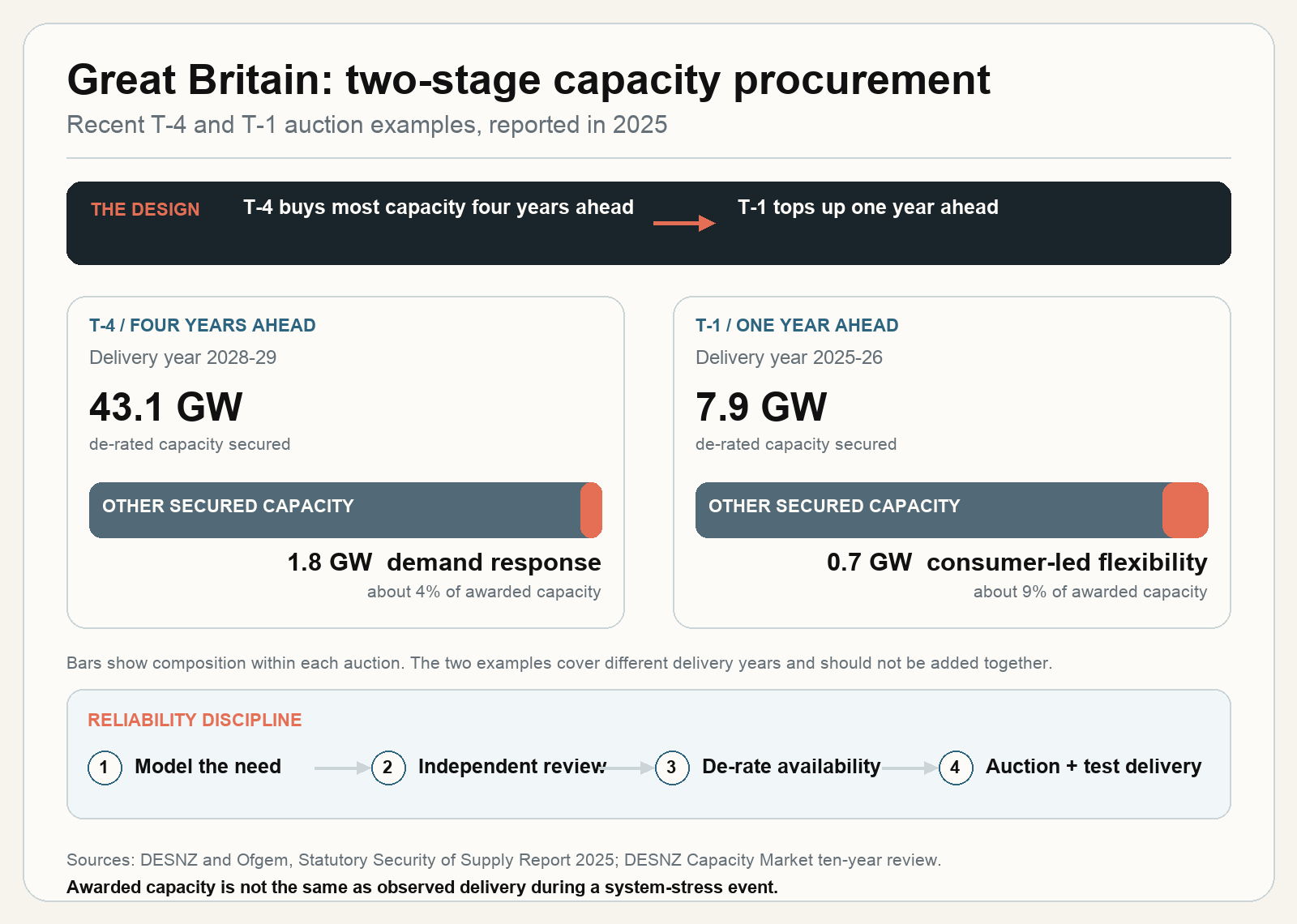
Great Britain offers a useful design check. Its capacity market secures most of the need four years ahead, then runs a one-year top-up as forecasts improve. An official 2025 security report says the one-year auction for 2025-26 secured 7.9 GW, including 0.7 GW of consumer-led flexibility; the four-year auction for 2028-29 secured 43.1 GW, including 1.8 GW of demand response. Each resource is ‘de-rated’, meaning only the share likely to be available at peak is counted. Independent experts review the modelling before the auction volume is set. A ten-year review reported no declared system-stress event since the market began but also recorded concerns about favouring existing generators. India can borrow the two-stage auction, independent review and delivery tests while publishing consumer cost, market concentration and actual performance. Awarded megawatts alone are not proof of reliability.
New market products cannot replace sound grid operations. States still need enough reserve, accurate balancing and enforceable operating rules. Grid control rooms should define measurable tests for response time, duration, location and availability. One megawatt on paper is not useful if it cannot arrive where and when the system needs it.
Reliability planning should not default to buying more long-term generation. Planners should compare generation with verified demand response, storage, peak-season contracts, sharing capacity between states, short-term purchases and upgrades to useful existing assets. As more solar and wind connect through power electronics rather than traditional rotating machines, the grid may also need new services to keep voltage and frequency steady. Markets should be created to solve a demonstrated need, and not appear to favour one technology over another.
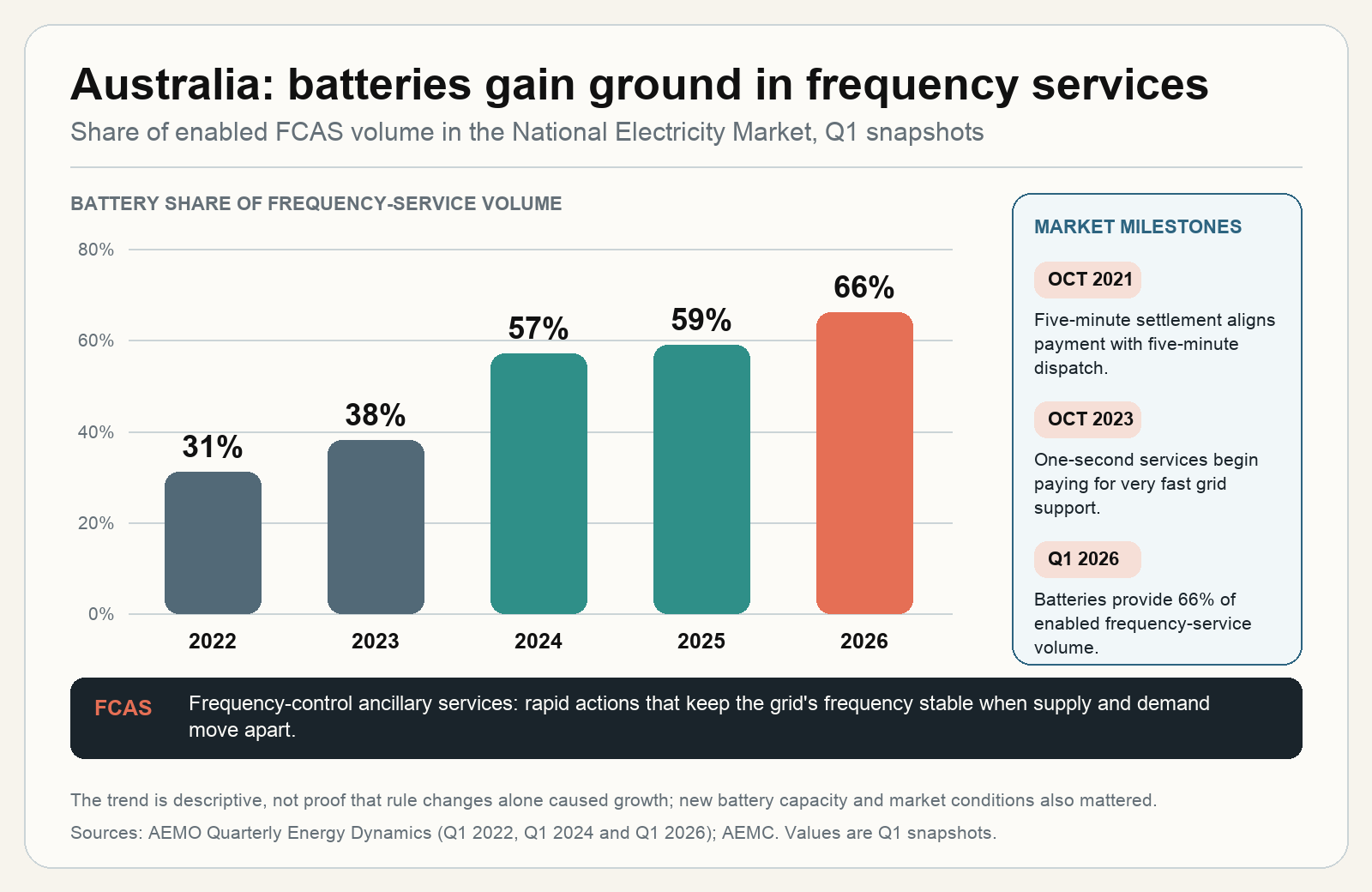
Australia shows how clearer, faster products can widen participation. Its five-minute settlement rule aligned financial settlement with five-minute dispatch in October 2021, and one-second frequency services opened in October 2023. Frequency-control ancillary services (FCAS) are rapid actions that keep the grid stable when supply and demand move apart. In the Australian system operator’s quarterly snapshots, batteries’ share of FCAS volume rose from 31% in early 2022 to 66% in early 2026. The trend does not prove that rule changes alone caused the growth; new battery capacity and market conditions mattered too.
The key is sequencing. Dispatch, metering and payment intervals should match before fast resources are asked to compete. Products should specify response speed, duration, measurement and availability; early volumes can be capped while participation develops. Reviews should publish prices, delivery and ownership concentration, because a fast market with only a few suppliers can still be expensive and fragile.
Storage becomes system infrastructure
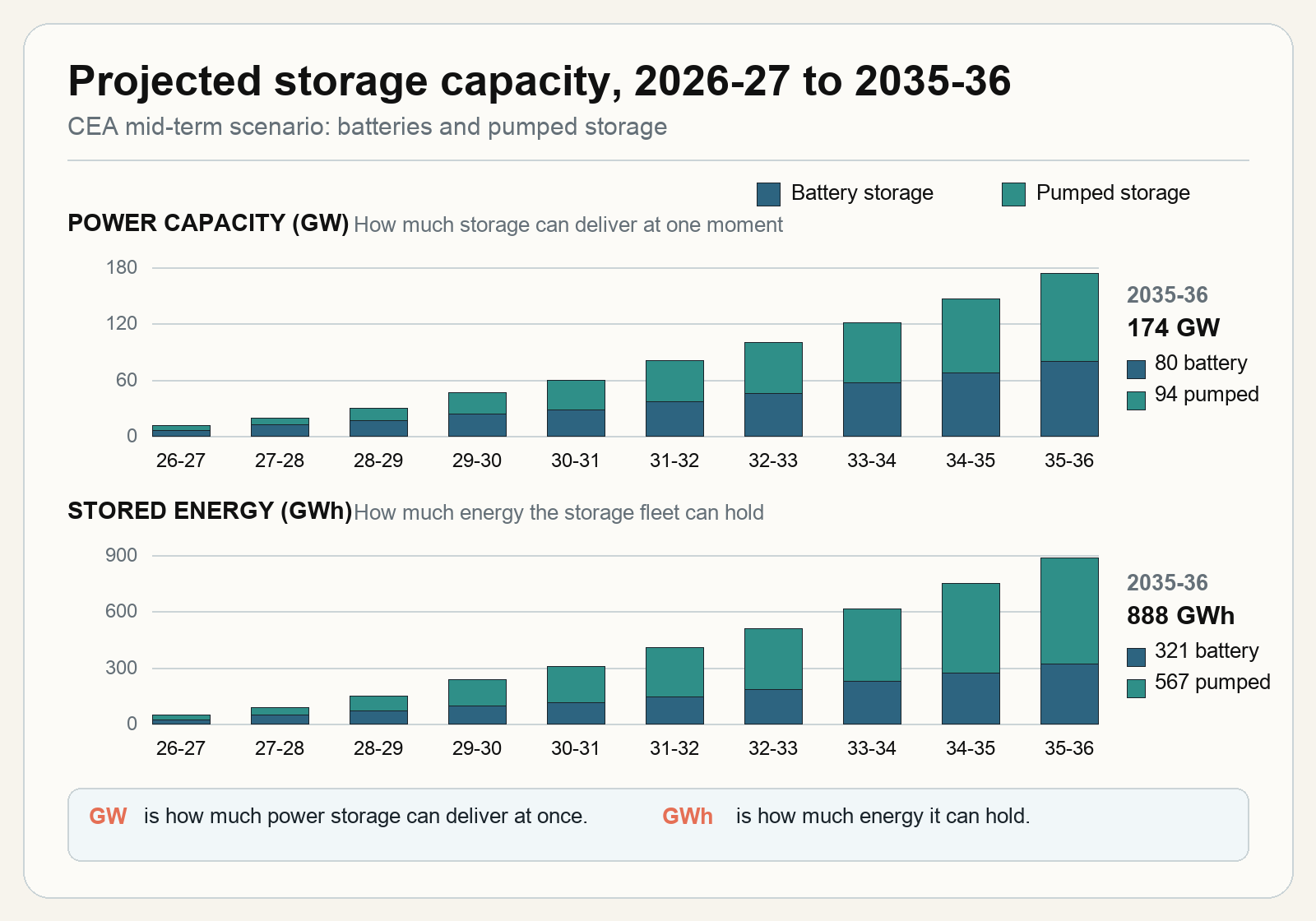
The CEA’s 2026 national resource-adequacy plan projects storage rising from 11 gigawatts (GW) and 51 gigawatt-hours (GWh) in 2026-27 to 174 GW and 888 GWh in 2035-36. GW measures how much power storage can deliver at one moment; GWh measures how much energy it can hold. By 2035-36, the plan includes 80 GW/321 GWh of batteries and 94 GW/567 GWh of pumped storage, which stores energy by moving water uphill and releasing it through turbines later. These are planning outputs, not purchase targets.
The draft allows storage to serve different roles: at a power plant, on the transmission or distribution network, at a customer site or as a stand-alone business. That flexibility is useful because a battery at a substation, a battery inside a factory and a pumped-storage project solve different problems. It also creates an accounting risk. If a regulated network battery recovers its cost from consumers, it should not charge the market again for the same service unless the rules clearly separate the two payments.
The fair rule is to pay for a service, not favour an asset label. Batteries, pumped storage and flexible demand should compete when they can meet the same response time, duration, location and availability test. Storage should not automatically be placed beside a renewable plant; another location may provide more value by easing a crowded line or supporting a local network. Contracts should also say whether storage may earn from several services and which obligation comes first during a system event.
The local grid becomes an operating layer
Much of the new coordination happens inside local distribution networks. Rooftop solar, small batteries, smart appliances, electric-vehicle fleets and factories that shift use can help the wider grid - but only if the local network can see and forecast them and tell whether a response will ease a bottleneck.
The draft’s answer is correctly a more active local grid. Smart meters, better maps, automated substations and prices that vary by time would give the DISCOM more visibility and control. Its proposed DSO function would coordinate local power flows. Aggregators would combine many small customers or devices so they can offer one reliable response. Consumers could choose to earn from flexibility; DISCOMs would move beyond buying bulk electricity and collecting bills toward forecasting and coordinating a changing local portfolio.
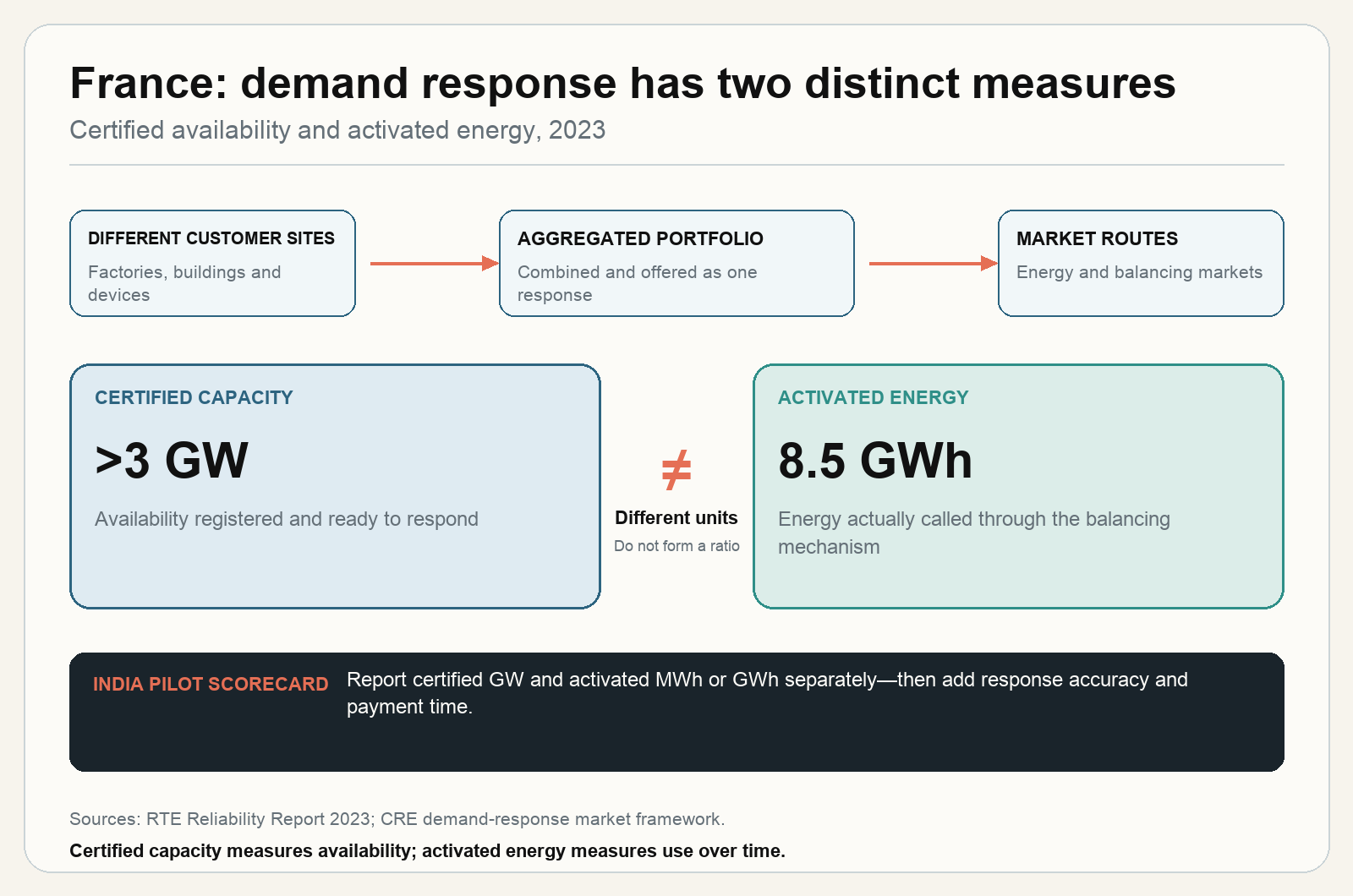
France shows how those permissions can become a route to several markets. Its demand-response framework allows an operator to combine different customer sites and offer the portfolio into energy and balancing markets. In 2023, slightly more than 3 GW of explicit demand response was certified, while 8.5 GWh was actually activated through the balancing mechanism, according to RTE’s reliability report. The two measures are different: certified GW describes availability; activated GWh describes energy used. Indian pilots should report both, so a large enrolment number cannot be mistaken for real delivery.
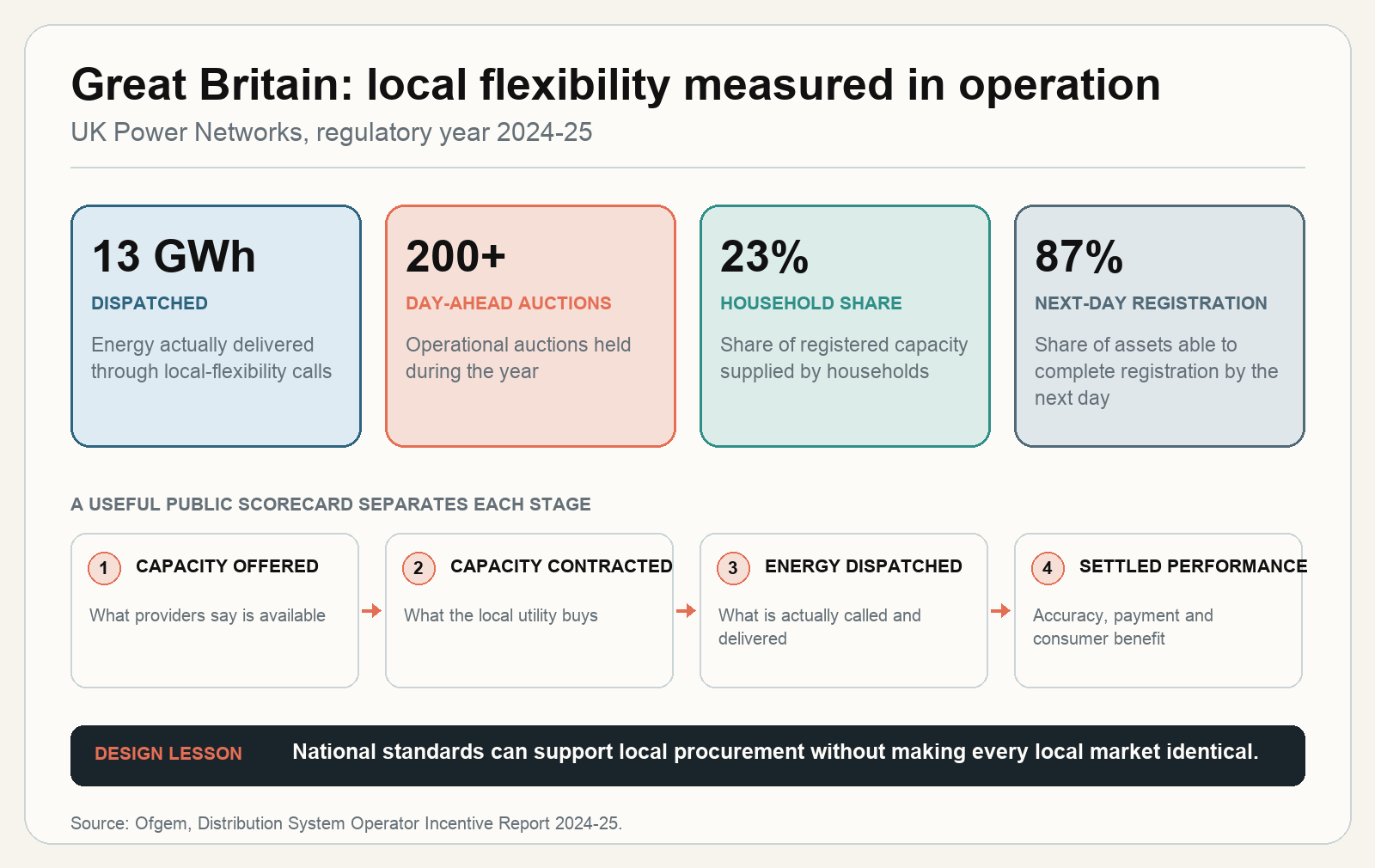
Local operation also needs proof. In Great Britain, UK Power Networks’ 2024-25 results show 13 GWh dispatched through more than 200 day-ahead local-flexibility auctions. Households supplied 23% of registered capacity, and 87% of assets could complete registration by the next day. India can combine state-level procurement with national standards for contracts, resource IDs, dispatch messages, baselines and settlement. The scorecard should separate capacity offered, capacity contracted and energy actually delivered.
Technology cannot repair weak finances by itself. If the electricity prices paid by customers do not cover reasonable costs, or payments arrive too late to support investment, better data may only describe the problem more precisely. Rules for customer consent, aggregator liability, complaints and local-network limits must be part of the first pilot. So must a credible baseline - the estimate of electricity use that would have occurred without an instruction - because payments for demand response depend on the difference.
Data is infrastructure, not a by-product
The India Energy Stack is meant to be the digital link between these reforms. The draft describes common standards that would let different systems exchange information, understand it in the same way and settle payments. A Ministry of Power parliamentary answer calls it a universal digital blueprint and says a phased small-scale test is planned for the 2026-27 financial year. That does not necessarily mean one giant database; it means shared identifiers, formats and rules.
The idea is important, but the rulebook is unfinished. The official India Energy Stack statement does not yet say which identifiers, data formats, consent controls, audit trails or dispute routes will be compulsory. Those choices will determine whether a rooftop-solar portfolio can operate across states or whether every system needs a new translation layer.
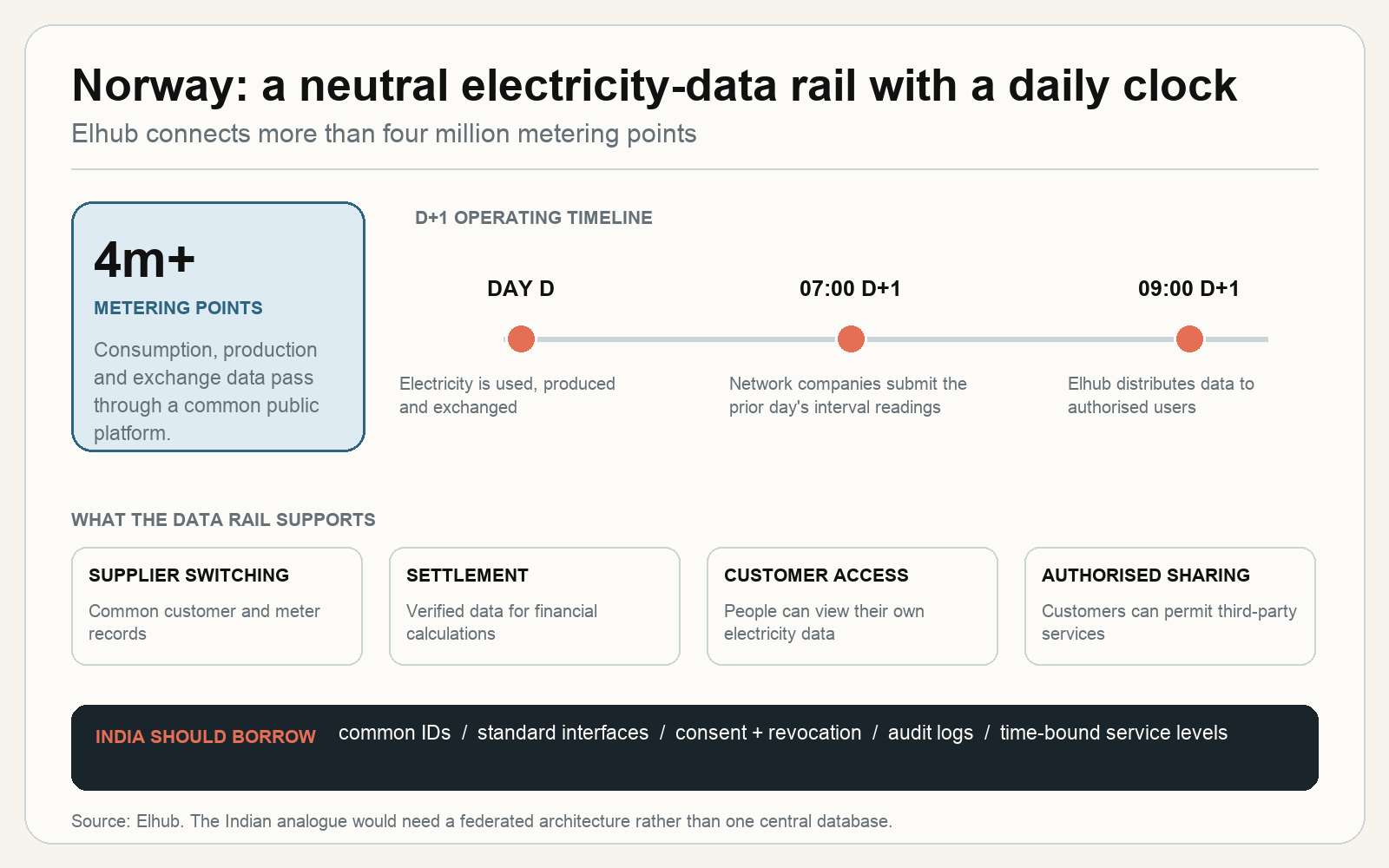
Norway’s Elhub shows what a neutral data rail looks like in operation. The publicly owned platform exchanges data for more than four million metering points, supports supplier switching and settlement, and lets customers view and authorise sharing of their own data. Network companies submit the previous day’s interval readings by 07:00; Elhub distributes them to authorised users by 09:00. India is far larger and more federal, so one central database would be a poor copy. The useful features are common resource identifiers, standard interfaces, customer consent and revocation, audit logs, data-quality targets and time-bound service levels across a federated system.
Useful grid data should be available in a form that regulators and independent analysts can examine. Access cannot be unlimited: personal information and commercially sensitive bids need clear ownership, purpose and permission. Critical grid and consumer data may also need to remain in India. Cybersecurity rules should cover smart-meter providers, aggregators and every third party that can reach the system, backed by independent audits and mandatory incident reports. Open data and security can work together when data is clearly classified, access is recorded and misuse has consequences.
Open access changes who buys power - and who pays
Open access allows an eligible large user to buy electricity from a supplier other than its local DISCOM while continuing to use the shared network. The draft proposes making network charges more predictable and gradually reducing extra charges. Some of those charges help fund lower tariffs for other consumer groups and cover costs already committed by the DISCOM. More predictable rules could make renewable contracts easier for industry to plan, but they also change who pays for the network and public-service duties.
The transition therefore needs transparent network tariffs, clear treatment of past commitments and a defined way to fund subsidies. If higher-paying users leave without a redesign of fixed-cost recovery, remaining customers may inherit the burden. If extra charges change unpredictably, open access exists in law but not as a dependable business option. The aim should be to separate social policy, network cost and competitive energy purchases so each can be governed openly.
A published transition calendar would make that separation credible. Charges for old commitments should be explicit, time-limited and predictable. Large users that choose another supplier should arrange normal backup through market contracts. The DISCOM can remain a supplier of last resort, but that emergency role should be limited and priced. Otherwise, competition can leave the local utility carrying costs and reliability duties that nobody funds.
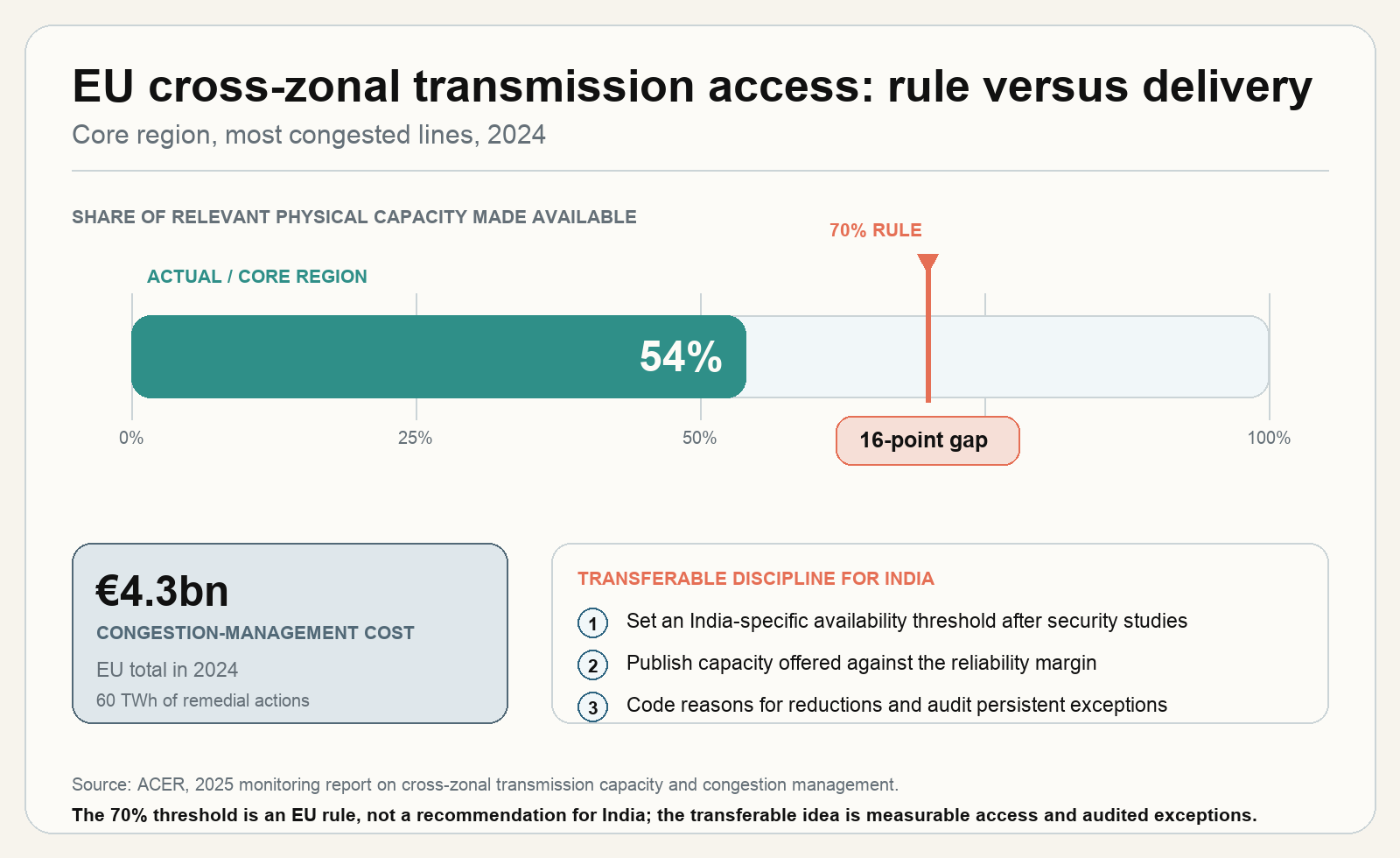
Europe’s cross-border market offers a measurement lesson. Operators are required to make at least 70% of relevant transmission capacity available for cross-zonal trade, after allowing for system security. Yet ACER’s 2025 monitoring found that only 54% was made available on the most congested lines in the Core region during 2024; managing congestion across the EU cost €4.3 billion for 60 TWh of remedial actions. India should not copy the 70% threshold without its own security studies. It can copy the discipline: publish available interstate capacity against a clear reliability margin, give coded reasons for reductions and audit persistent exceptions.
A platform still needs accountable institutions
Responsibility is spread across many institutions. CEA leads national planning. CERC sets many interstate market and access rules, while state commissions regulate local tariffs and utilities. Grid-India, the national system operator, and state control rooms keep supply and demand balanced. DISCOMs serve customers, and the proposed DSO function would coordinate local-network flows. Aggregators combine small resources; exchanges and settlement systems match trades and payments. A common platform can connect these roles, but it cannot resolve conflicts between them.
Those institutions need neutral rules. A state transmission plan should not favour the company that may later build the project, and major generation and network investments should be compared in one plan based on total system cost before contracts are signed. State control rooms need measurable balancing rules and automatic controls that are actually enforced, while market monitoring should cover exchanges, private contracts, open access, companies that generate their own power and peer-to-peer trades.
Four tests for implementation
1. Use common definitions. National institutions should define capacity, flexibility, normal-use baselines, availability, measurement and payment in the same way. States can adapt products to local needs, but a megawatt should not change meaning when it crosses a border.
2. Set data and payment rules first. Common grid-resource IDs, accurate meter data, consent rules, minimum cybersecurity rules and payment deadlines are essential. They show operators whether a response is real and investors whether payment can be trusted.
3. Pilot real problems. A trial should start with a clear need: an evening demand spike, wasted solar output, an overloaded substation or a factory that can shift use. It should report the expected result without the trial, the instructions, delivery, payment and an independent audit.
4. Publish outcomes. Regulators should publish backup supply, peak reduction, unused renewable energy, network congestion, how often and how long power fails, payment delays, whether a few sellers dominate and consumer savings. Public scorecards help scale what works and stop what does not.
The five reforms are different, but they rely on the same foundations: clear contracts, tools to manage price risk, system-wide scheduling and monitoring across the whole market.
The reform is the operating system
The draft identifies the right problem. India does not need only a larger grid; it needs one that can see more, respond faster and coordinate more participants. Capacity markets, aggregators, active local networks and digital settlement may help, but none can transform the system alone. Their value comes from working together.
That is the standard by which the final policy should be judged. The grid becomes a platform when large and small resources can prove what they can do, operators can trust the data, payment follows verified performance and responsibility remains clear when something fails. Software can carry those rules. The reform is the rules themselves.
Sources & notes
1. Ministry of Power - Draft National Electricity Policy 2026 (consultation draft, January 2026)
2. CERC - Monthly Report on Short-term Transactions, February 2026
3. CERC - Staff Paper on Capacity Market for Electricity in India, April 2026
4. CEA - Long-term National Resource Adequacy Plan 2026-27 to 2035-36
5. Ministry of Power - Parliamentary answer on the India Energy Stack, December 2025
6. CERC - Ancillary Services Regulations, 2022
7. DESNZ and Ofgem - Great Britain Statutory Security of Supply Report 2025
8. DESNZ - Great Britain Capacity Market ten-year review, 2024
9. AEMC - Australia five-minute settlement rule
10. AEMO - Quarterly Energy Dynamics, Q1 2022
11. AEMO - Quarterly Energy Dynamics, Q1 2024
12. AEMO - Quarterly Energy Dynamics, Q1 2026
13. CRE - France demand-response market framework
14. RTE - France Reliability Report 2023
15. Ofgem - Distribution System Operator Incentive Report 2024-25
16. Elhub - Norway’s national electricity-data platform
17. ACER - Cross-zonal capacity and congestion monitoring, 2025