 uogent®
Policy Note / Artificial Intelligence & Sovereign Models
Open Weights and Closed Labs Are Not a Zero-Sum Contest
Why frontier AI services and sovereign, open-weight systems are likely to grow together.

The debate over advanced AI is often staged as a contest between two camps. On one side are the large labs: well-capitalized firms that train highly capable proprietary models and serve them through controlled products or APIs. On the other are open-weight models, whose learned parameters can be downloaded, modified and run by others. The usual question is which side will win.
That is probably the wrong question. These categories overlap, compete for some workloads and borrow techniques from one another, but they optimize for different things. Closed labs are building managed intelligence services at the frontier of general capability. Open-weight ecosystems are building the foundations for controllable, portable and decentralized intelligence. A healthy AI economy needs both.
The policy challenge is to preserve the conditions under which frontier services and sovereign AI systems can coexist - while managing the distinct risks created by each.
Start with the right terms
“Open weight” is not the same as “open source.” An open-weight release makes a model’s parameters available for download, but may not disclose the training data, full training code or complete recipe needed to reproduce it. The Open Source AI Definition sets a higher bar: the freedoms to use, study, modify and share the system, supported by the information and code needed to make those freedoms meaningful.
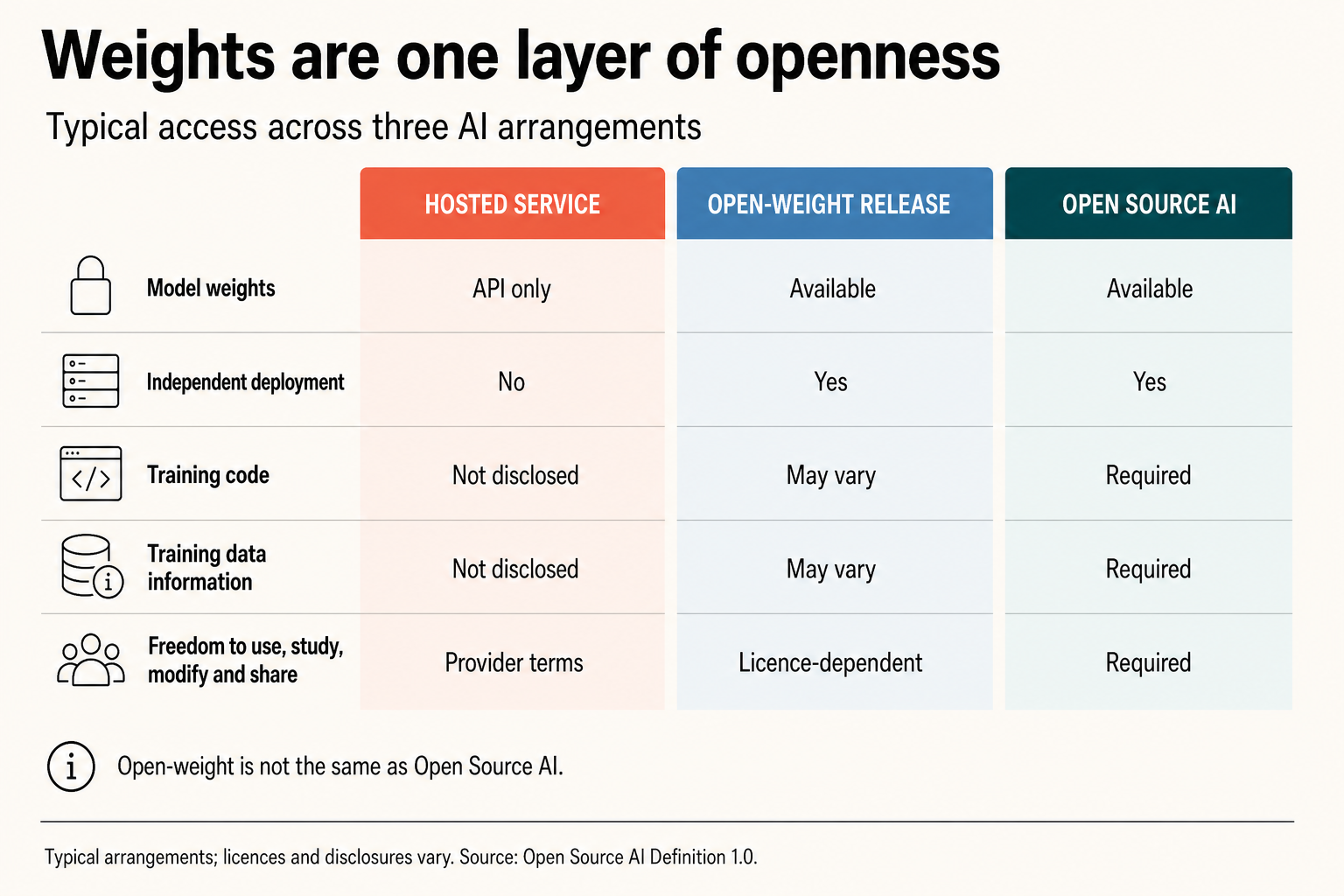
Access to weights undoubtedly gives users far more control than access through an API, but less visibility than a reproducible open-source project. Framing and narratives that collapses all three arrangements - hosted, open-weight and fully open - risk misreading both their benefits and their risks.
That said, open weights essentially allow developers to apply new custom harnesses and semantic planning/enhancement layers, as well as fine-tune the models just as they would an open source AI model release. In that regard, open weight and open source models are near identical.
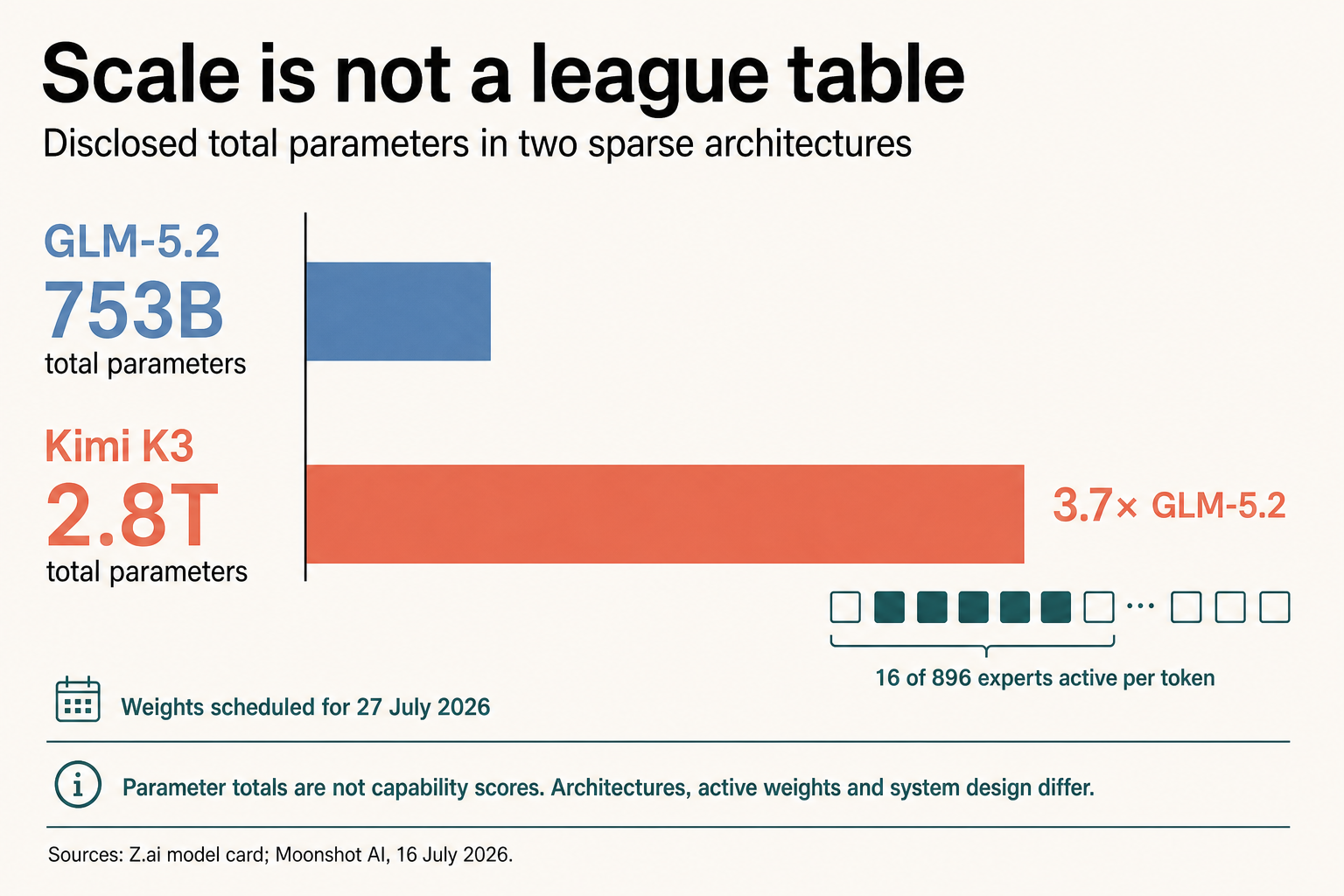
It is also a mistake to treat parameter count as a league table. Open-weight models - and models announced for near-term weight release - have reached enormous scale. Z.ai’s GLM-5.2 is a roughly 753-billion-parameter sparse model. Moonshot’s Kimi K3, announced on July 16, is larger still at 2.8 trillion parameters, while activating just 16 of 896 experts. Recent reporting highlights frontier-level results in some coding and text tests, but also an important caveat: K3’s weights are not due until July 27, and its earliest benchmarks have had little real-world validation. None of these totals is directly comparable. Architectures differ, sparse models use only a fraction of their weights per token, and leading closed labs often disclose no parameter counts at all. Parameter scale matters, but it does not by itself guarantee system quality.
Why the largest labs retain an advantage
Closed AI offerings have evolved into engineered systems, and are no longer the model checkpoints they were just a few years ago. OpenAI’s GPT‑5.6 combines adjustable reasoning, programmatic tool orchestration and an ultra setting coordinating multiple agents in parallel. Anthropic’s Claude Fable 5 shows another pattern: inside Claude Code or Managed Agents, it can sustain days-long tasks, delegate to sub-agents and check its own work. In both cases, the advantage comes from the model, orchestration, tools and infrastructure - and not weights alone.
Large labs can improve every layer of that stack together. They can invest heavily in curated data, reinforcement learning, human feedback, synthetic training environments, red-teaming, evaluation infrastructure and specialized inference hardware. At product scale, they also receive a stream of evidence about where users succeed or fail. That feedback can become new evaluations, training signals and product fixes.
This cumulative system advantage is difficult to reproduce. An open-weight model may look close to a closed model on a static benchmark yet fall behind in a long, messy task that requires planning, recovery from errors and dependable tool use. The missing ingredient is not always a larger base model. It may be the router, the agent harness, the private evaluation suite, the quality of post-training or the operational discipline around deployment.
None of this means closed models will dominate every use case. It means the leading labs sell a level of integrated, maintained quality that cannot be inferred from parameter counts alone.
What open weights make possible
Open-weight models solve a different set of problems. They allow an organization to choose where inference happens, pin a version, modify behavior, inspect the surrounding code and change providers without rebuilding an application from scratch. They can run inside a company’s security boundary, in a national or regional cloud, at the edge, or - in smaller forms - on a personal device.
That control matters for hospitals, governments, manufacturers, researchers and any organization whose data or operating knowledge is strategically sensitive. A private agent that works across internal documents, workflows and communications can accumulate a rich institutional memory. Even when a hosted provider promises not to train on customer inputs, the customer may still depend on that provider’s pricing, product roadmap, access rules, jurisdiction and availability. Self-hosting does not eliminate risk, but it changes who can make those decisions.
Open weights also widen participation. Researchers can probe a model below the application layer. Developers can adapt models for underserved languages and specialized domains. Smaller firms can create products without seeking permission from a model owner. Communities can improve inference engines, quantization, evaluation and safety tooling that benefit many models at once.
The trade-offs are real. Operating a large model well requires scarce engineering talent, compute, security work and ongoing evaluation. Local deployment is not automatically cheaper, safer or more private; a poorly secured self-hosted system can be worse on all three counts.
The relevance and importance of open weight models comes from the autonomy and option value they create.
A coexistence agenda
In practice, many capable organizations will use a portfolio. A managed frontier model may handle the hardest, most variable tasks. A smaller open-weight model may handle predictable, high-volume or latency-sensitive work. A privately adapted model may operate over confidential data. A routing layer may choose among them according to quality, cost, risk and location.
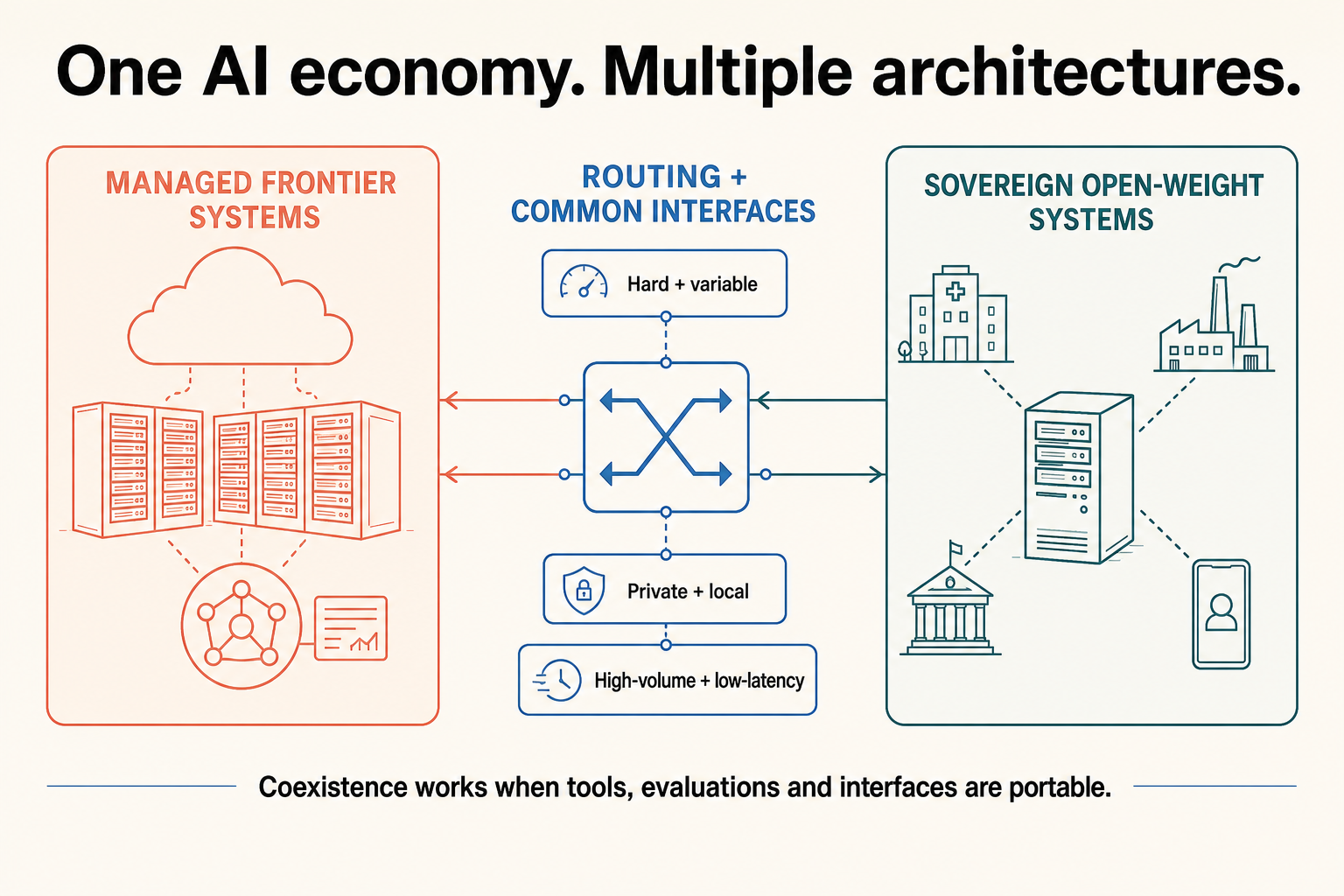
Policy should make that mixed architecture easier and safer.
First, regulate capabilities and deployment contexts, not labels. “Open” does not mean harmless, and “closed” does not mean controlled in every meaningful sense. Evaluation, incident reporting and release obligations should scale with demonstrated capability, the reversibility of distribution and the consequences of the intended use.
Second, invest in the ecosystem around open weights. Public compute access, high-quality datasets, multilingual resources, secure inference software and model-maintenance institutions matter as much as another downloadable checkpoint. If policymakers want a genuine counterweight to concentrated labs, they must support the infrastructure that turns weights into dependable systems.
Finally, preserve competition at both layers. Policymakers should resist dependencies that can potentially lock customers into one model provider, but also avoid rules that entrench only the largest organizations as capable of compliance. Common interfaces, portable evaluations and interoperable agent tools can make both hosted and self-run models more replaceable.
The frontier labs are likely to keep producing the most polished general-purpose AI systems. Their scale in compute, data, post-training, product engineering and evaluation compounds into performance. Open-weight models will continue to narrow parts of the gap, but their larger contribution is not merely chasing the top benchmark.
It is ensuring that advanced AI can also be owned, adapted, studied and run outside a handful of central services. The plausible future is not one architecture defeating the other. It is powerful lab-built agents working alongside private organizational agents, regional systems and personal models. Good policy should prepare for that coexistence - and keep it genuinely open.